
Products
What is the difference between 506b and 506c funds?
What is the difference between 506b and 506c funds?
Addhyan Negi
·
Today’s fund managers compete on speed.
And when you’re building a fund, it’s important to get the small details right. The costs of getting the small details wrong can be immense.
A small (but important) detail about your fund is whether it’s a 506b or 506c fund.
For example, one type allows you to advertise your fund and meet new, potential investors through Twitter or social media. The other type forbids advertising of any kind.
The differences between a 506b and a 506c fund are small but they matter. And knowing these differences allows you to build, raise, and close your funds faster.
To start, here are the high-level differences between a 506b and a 506c fund.
1. FAQs about the difference between 506b and 506c funds
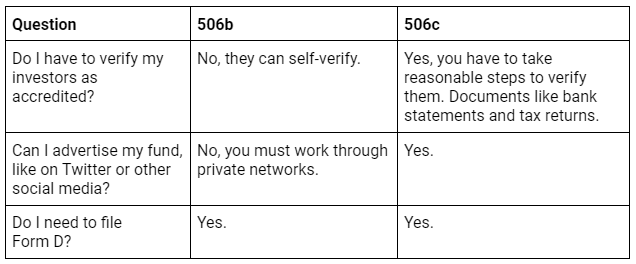
These are high-level questions with over-generalized answers. This table is by no means a source of authority.
It’s simply meant to illustrate some basic differences. These are the details we’d give you if we saw you in a coffee shop.
At Allocations, we adhere to the rules of the Investment Co. Act. We recommend you take a look at the Act if you’re going to make any important decisions about your funds.
2. What is Regulation D and why does it matter?
Regulation D (Reg D) is an SEC regulation that deals with the sale of stock shares or bonds to a small group of curated investors.
It doesn't concern companies offering equity in the public markets, like a stock exchange.
Reg D was created to help private companies raise money faster and cheaper, without having to register with the SEC (Securities and Exchange Commission). It allows the private company or startup to raise money through the sale of equity, which is an ownership percentage of the company or startup.
As a fund manager, Reg D is your friend because it allows you to place capital fast.
3. What is an accredited investor?
You’re an accredited investor if you meet at least one of these qualifications:
you have an individual or joint net worth more than $1M (this excludes the value of your primary residence)
you’ve had $200,000 income in each of the last two (2) years
you’ve had $300,000 joint income in each of the last two (2) years
you’re professional certification qualifies you as an accredited investor
you're a Director or Executive Officer of the Fund’s General Partner
you’re a knowledgeable employee of the private fund or its managers (this includes employees, executive directors, directors, trustees, and advisory board members. You also need to have at least 12 months tenure)
If you’re an entity, you must meet at least one of these qualifications:
each equity owner of your entity is an accredited investor
your entity has total assets worth more than $5M
you’re a “family office” with $5M+ assets under management (AUM)
you’re an Investment Advisor
you’re an Exempt Investment Adviser
you’re a private business development company
you’re an investment company or a business development company
you’re a Small Business Investment Company
4. What is a non-accredited investor?
Put simply, a non-accredited investor is the inverse of an accredited investor:
you do not have an individual or joint net worth more than $1M
you have not had $200,000 income in each of the last two (2) years
you have not had $300,000 joint income in each of the last two (2) years
you are not professional certification qualifies you as an accredited investor
you are not a Director or Executive Officer of the Fund’s General Partner
you are not a knowledgeable employee of the private fund or its managers
You may hear people refer to non-accredited investors as “retail investors” or “main street investors”. These terms are interchangeable.
5. Quick way to figure out which fund is right for you
Each fund and fund manager are unique.Here’s a basic test to figure out which type of fund may be right for your unique situation:506b funds may be better if …you have a robust network of investors to raise fromyou want to raise capital fastyou want to minimize costs506c funds may be better if …you have the time and resources to verify your investorsyou’d like to advertise your fundRegardless of your situation, Allocations can help you decide.10,000+ investors and fund managers build, raise, and close funds on Allocations — the fastest and most advanced fund platform in the world. Build your next SPV or Fund today
Disclaimer: The information provided in this document does not, and is not intended to, constitute legal, tax, investment, or accounting advice; instead, all information, content, and materials available are for general informational or educational purposes only and it represents the personal view of the author. Please consult with your own legal, accounting or tax professionals.
Today’s fund managers compete on speed.
And when you’re building a fund, it’s important to get the small details right. The costs of getting the small details wrong can be immense.
A small (but important) detail about your fund is whether it’s a 506b or 506c fund.
For example, one type allows you to advertise your fund and meet new, potential investors through Twitter or social media. The other type forbids advertising of any kind.
The differences between a 506b and a 506c fund are small but they matter. And knowing these differences allows you to build, raise, and close your funds faster.
To start, here are the high-level differences between a 506b and a 506c fund.
1. FAQs about the difference between 506b and 506c funds
These are high-level questions with over-generalized answers. This table is by no means a source of authority.
It’s simply meant to illustrate some basic differences. These are the details we’d give you if we saw you in a coffee shop.
At Allocations, we adhere to the rules of the Investment Co. Act. We recommend you take a look at the Act if you’re going to make any important decisions about your funds.
2. What is Regulation D and why does it matter?
Regulation D (Reg D) is an SEC regulation that deals with the sale of stock shares or bonds to a small group of curated investors.
It doesn't concern companies offering equity in the public markets, like a stock exchange.
Reg D was created to help private companies raise money faster and cheaper, without having to register with the SEC (Securities and Exchange Commission). It allows the private company or startup to raise money through the sale of equity, which is an ownership percentage of the company or startup.
As a fund manager, Reg D is your friend because it allows you to place capital fast.
3. What is an accredited investor?
You’re an accredited investor if you meet at least one of these qualifications:
you have an individual or joint net worth more than $1M (this excludes the value of your primary residence)
you’ve had $200,000 income in each of the last two (2) years
you’ve had $300,000 joint income in each of the last two (2) years
you’re professional certification qualifies you as an accredited investor
you're a Director or Executive Officer of the Fund’s General Partner
you’re a knowledgeable employee of the private fund or its managers (this includes employees, executive directors, directors, trustees, and advisory board members. You also need to have at least 12 months tenure)
If you’re an entity, you must meet at least one of these qualifications:
each equity owner of your entity is an accredited investor
your entity has total assets worth more than $5M
you’re a “family office” with $5M+ assets under management (AUM)
you’re an Investment Advisor
you’re an Exempt Investment Adviser
you’re a private business development company
you’re an investment company or a business development company
you’re a Small Business Investment Company
4. What is a non-accredited investor?
Put simply, a non-accredited investor is the inverse of an accredited investor:
you do not have an individual or joint net worth more than $1M
you have not had $200,000 income in each of the last two (2) years
you have not had $300,000 joint income in each of the last two (2) years
you are not professional certification qualifies you as an accredited investor
you are not a Director or Executive Officer of the Fund’s General Partner
you are not a knowledgeable employee of the private fund or its managers
You may hear people refer to non-accredited investors as “retail investors” or “main street investors”. These terms are interchangeable.
5. Quick way to figure out which fund is right for you
Each fund and fund manager are unique.Here’s a basic test to figure out which type of fund may be right for your unique situation:506b funds may be better if …you have a robust network of investors to raise fromyou want to raise capital fastyou want to minimize costs506c funds may be better if …you have the time and resources to verify your investorsyou’d like to advertise your fundRegardless of your situation, Allocations can help you decide.10,000+ investors and fund managers build, raise, and close funds on Allocations — the fastest and most advanced fund platform in the world. Build your next SPV or Fund today
Disclaimer: The information provided in this document does not, and is not intended to, constitute legal, tax, investment, or accounting advice; instead, all information, content, and materials available are for general informational or educational purposes only and it represents the personal view of the author. Please consult with your own legal, accounting or tax professionals.

Addhyan Negi
Director of Marketing, Allocations

Start your next SPV
in 10 minutes
Start your next SPV in 10 minutes
Start your next SPV
in 10 minutes
Read related articles
Allocations secondary market is operated through Allocations Securities, LLC dba AllocationsX, member FINRA/SIPC. Check this firm on FINRA BrokerCheck. Allocations Securities, LLC is a wholly owned subsidiary of Allocations, Inc.
Copyright © Allocations Inc
Allocations secondary market is operated through Allocations Securities, LLC dba AllocationsX, member FINRA/SIPC. Check this firm on FINRA BrokerCheck. Allocations Securities, LLC is a wholly owned subsidiary of Allocations, Inc.
Copyright © Allocations Inc
Allocations secondary market is operated through Allocations Securities, LLC dba AllocationsX, member FINRA/SIPC. Check this firm on FINRA BrokerCheck. Allocations Securities, LLC is a wholly owned subsidiary of Allocations, Inc.
Copyright © Allocations Inc