Special purpose vehicles stopped being a niche venture tool years ago. By July 2026, SPVs and the fund structures built around them are core infrastructure for solo GPs, syndicate leads, family offices, and institutional managers who need to move on a deal in days, not weeks — across asset classes, across borders, and without inheriting a back office they never wanted to build.
The platform you choose now determines how fast you can close, what you can hold, where your investors can come from, and what your operation looks like three years from now when a deal exits. The wrong choice doesn't stop you from running an SPV. It just adds friction at every stage: slower onboarding, a narrower set of assets you can support, less control over the investor experience, and surprise invoices that show up after the fact.
This is a working ranking of the ten platforms that matter most in July 2026. The order reflects how each platform performs against the criteria sophisticated managers actually weigh today:
End-to-end coverage — formation, banking, onboarding, compliance, reporting, and distributions in one place versus a stack of stitched-together tools
Asset and jurisdiction flexibility — venture only, or venture plus crypto, real estate, private credit, secondaries, and international investors
Pricing transparency — published, predictable pricing versus "contact sales"
Speed — time from idea to a fundable entity
Trust signals — regulatory standing, track record, and how a platform handles your data and your LP relationships
Fit for repetition — built for managers who run vehicles continuously, not one-off syndicates
Here's where things stand.
At a glance
Rank | Platform | Best for | Headline pricing | Key limitation |
|---|---|---|---|---|
1 | Allocations | Managers who treat SPVs and funds as repeatable infrastructure across any asset type | Published: $9,950 standard SPV / $19,500 premium SPV / $19,500 per year fund | Priced for serious managers, not the cheapest single-deal option |
2 | AngelList | US syndicate leads embedded in the AngelList investor ecosystem | ~$8,000 setup + ~$2,000 state filing; deferred until close | Ecosystem dependency; investor experience under AngelList's brand |
3 | Carta | Firms already standardized on Carta for cap tables and fund admin | $1,500 implementation + custom per-annum administration | SPVs are an adjacent product; quote-based; venture-centric templates |
4 | Sydecar | Clean, low-cost single venture SPVs | Flat 2% of raise (min $4,500 / max $12,500), no carry | Delaware-only, venture-only, 506(b)-only, USD-only |
5 | Juniper Square | Large PE and real estate funds with dedicated back offices | Enterprise subscription, scales with fund size | Enterprise minimums and onboarding; overkill for lean teams |
6 | Odin | Cross-border European and transatlantic syndicates | From ~$6,000 per deal | Smaller scale; lighter US footprint than incumbents |
7 | Roundtable | EU-domiciled SPVs and angel communities | 1% of raise (min ~€5,000), covers ~7 years | Europe-focused; PFIC complexity for US investors |
8 | Anduin | Teams that want best-in-class subscription document automation | Custom | Point solution — not a full SPV/fund platform |
9 | Passthrough | Managers who need elite KYC/AML and investor onboarding | Custom | Point solution — handles onboarding, not the vehicle |
10 | Republic | Reaching retail and community investors at scale | Varies by offering | Marketplace model; not built as private GP infrastructure |
1. Allocations — the platform built for how modern managers actually operate
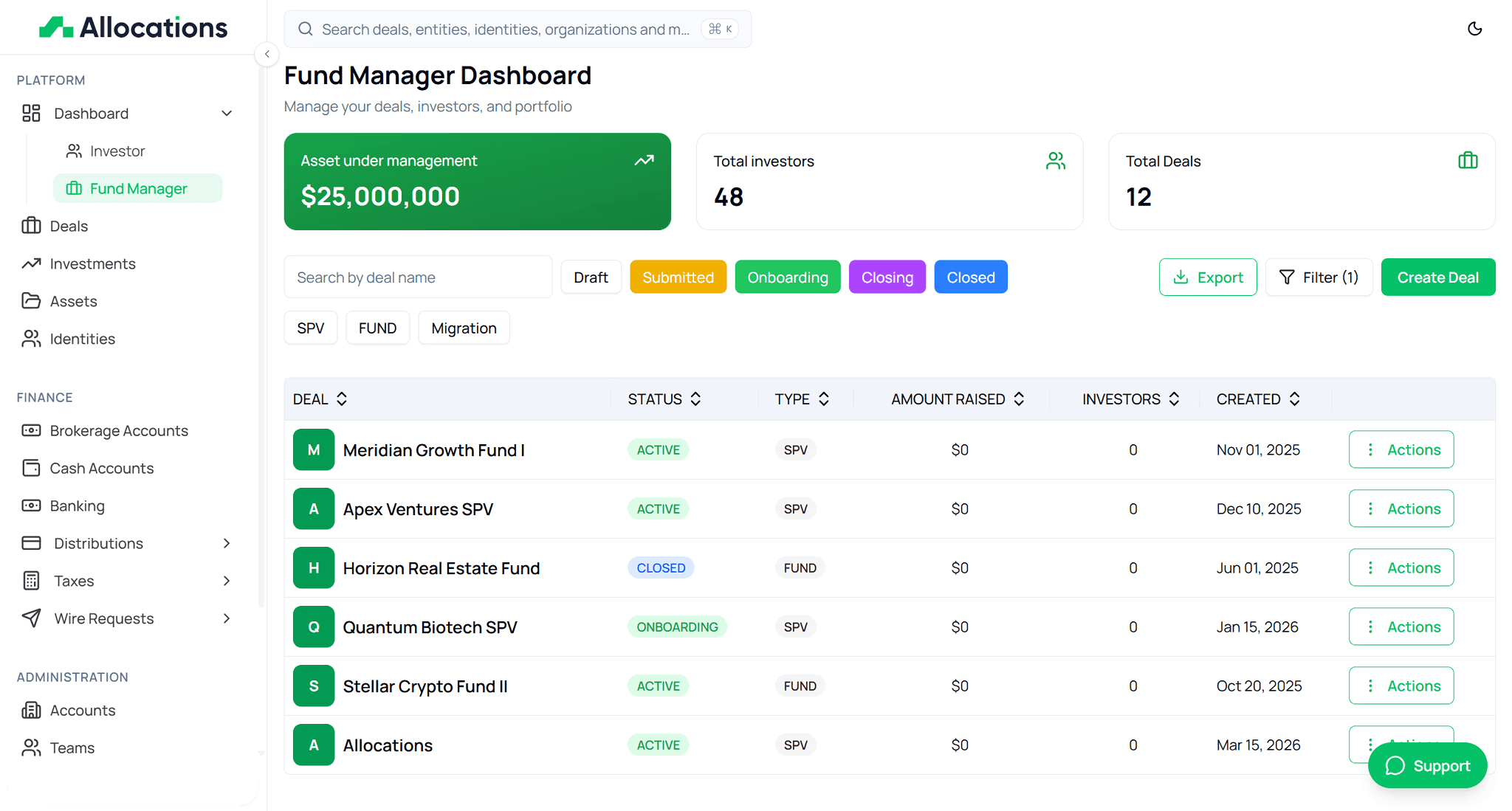
Allocations earns the top spot because it is the only platform on this list designed end to end around the way private capital works in 2026: any asset, global investors, fast closes, and the ability to run vehicle after vehicle without renegotiating cost or re-learning the workflow each time.
Why it leads:
True end-to-end infrastructure. Formation, banking, KYC/AML, investor onboarding, compliance, reporting, and distributions live in one platform. There's no separate legal invoice for basic compliance and no add-on charge buried in the fine print for standard administration. A standard SPV covers entity formation, template legal documents, onboarding for up to 35 investors, banking setup, and full administration for a five-year term — in one price. That's a different experience from assembling a point solution for onboarding, another for documents, and an administrator for the books.
Any asset type — not just venture. Token allocations, real estate syndications, secondary positions, private credit, and structured alternatives are all supported. The Premium SPV exists precisely because most modern deals are no longer "simple VC investments." Several platforms on this list only support Delaware venture equity; Allocations was built for the full opportunity set.
Broker-dealer credentials and a real secondary market. Allocations' secondary market is operated through Allocations Securities, LLC (dba AllocationsX), a member of FINRA/SIPC. That regulatory standing — verifiable on FINRA BrokerCheck — is a trust and liquidity signal most SPV tools simply do not have. For sophisticated LPs, it's the difference between a software vendor and regulated financial infrastructure.
Published, transparent pricing. Standard SPV at $9,950, Premium SPV at $19,500, VC fund administration at $19,500 per year, and a standalone migration vehicle at $1,950 per year. Managers can model total cost before launching rather than discovering it mid-cycle. Compare that to the "contact sales" model that still dominates the enterprise end of the market.
Built for repetition and global capital. International investors, multiple closes, and cross-border structures are first-class workflows, not exceptions. Managers can launch vehicles continuously, give investors a consistent onboarding experience every time, and consolidate legacy vehicles from fragmented providers onto a single dashboard.
Infrastructure, not a marketplace. Allocations never inserts itself between you and your LPs, and never markets other deals to your investors. Your relationships stay yours. That positioning — a neutral infrastructure layer rather than a marketplace that monetizes your investor base — matters more every year.
The honest trade-off: Allocations is priced for managers who treat SPVs as a serious, ongoing part of their strategy. For someone running a single tiny domestic angel deal once and never again, a percentage-of-raise option can look cheaper on day one. But for anyone who plans to do this more than once, or to hold anything other than plain venture equity, the predictability and breadth pay for themselves quickly.
2. AngelList
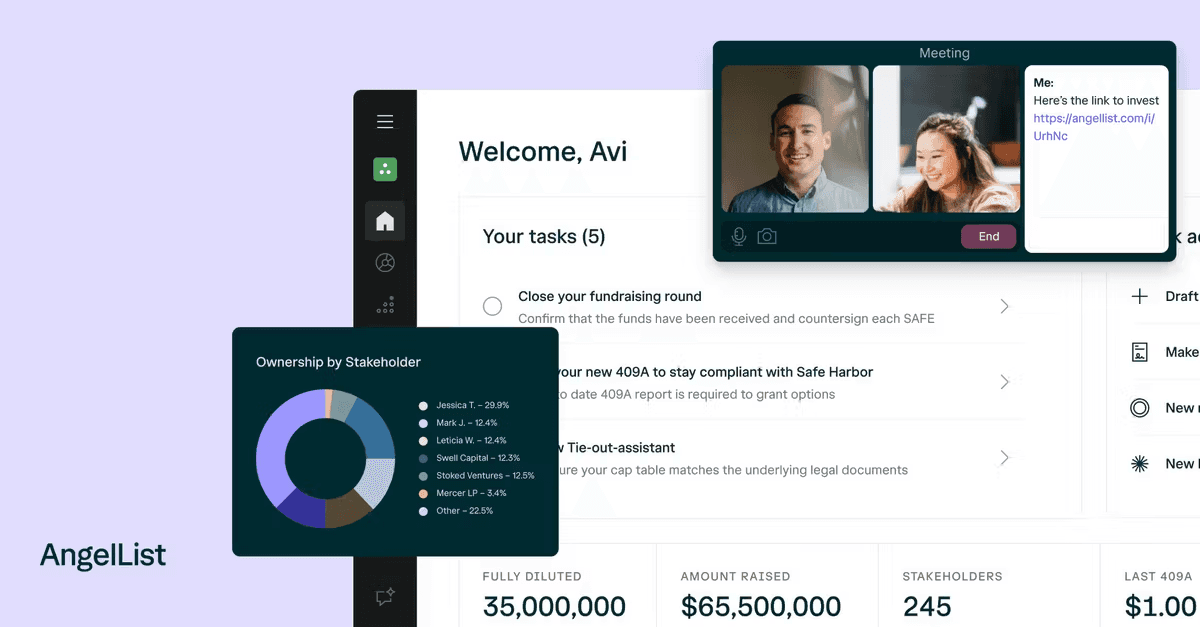
AngelList effectively created the modern syndicate category, and its Rollup Vehicles (RUVs) remain a credible, well-built way to consolidate dozens of angel checks into one clean line on a cap table.
Pros:
Large, recognizable investor ecosystem — useful if your LPs already have AngelList accounts
Deferred payment model: founders and leads pay only when the vehicle closes, with total fees capped at 10% of the amount raised
Zero carry charged to investors on the base product
Deep brand recognition in US venture
Cons:
Pricing stacks up with add-ons: a roughly $8,000 base plus a ~$2,000 state regulatory filing fee, with a 5% carry charged to the GP specifically on capital raised from AngelList Platform LPs, plus extra fees for crypto, international, and blocker entities
The investor experience is delivered under AngelList's brand, not yours
Workflows are optimized for individual deals; managers report friction as they scale into rolling funds, complex LP compositions, or institutional structures
Onboarding is smoothest for investors already inside AngelList's ecosystem
Where Allocations pulls ahead: Allocations gives you the same clean cap-table outcome without ecosystem lock-in. Your investors onboard under your brand, your assets aren't limited to what fits a venture template, and your pricing is published and predictable rather than assembled from base fees plus situational add-ons.
3. Carta
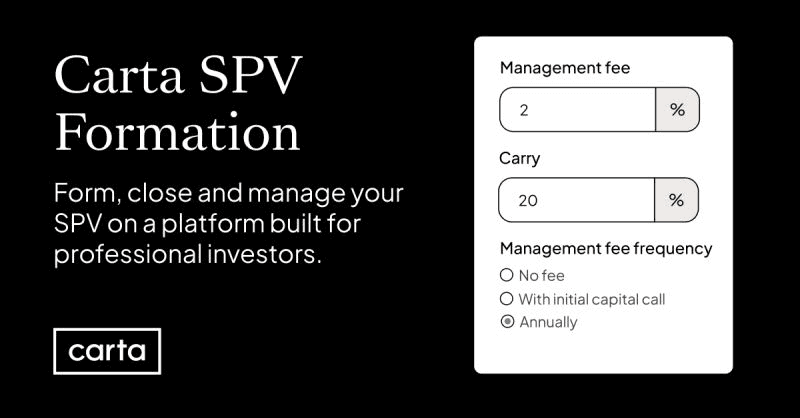
Carta is one of the most recognized names in private markets, anchored by its dominant cap table business and a large fund administration arm — roughly 9,000 funds and SPVs and more than $220 billion under administration, with international reach added through its 2022 acquisition of Vauban (covering US, UK, BVI, and Luxembourg structures).
Pros:
Enormous scale and brand trust
Tight integration if you already manage your cap table and fund admin on Carta
International structuring options through the Vauban platform
Expedited Delaware formation available, with a low $1,500 implementation fee to start
Cons:
SPVs often feel like an adjacent product rather than a core operating layer; the platform is most opinionated about cap tables, not deal-by-deal vehicles
Per-annum administration pricing is quote-based and varies by structure and complexity
Formation templates are limited to specific Delaware (and UK LLP) structures, with extra fees for GP/manager entity formation
Carta sits on both sides of many deals — the company's cap table and the fund investing in it — which has drawn scrutiny over data handling and conflicts, a recurring topic among managers evaluating where their information lives
Where Allocations pulls ahead: For managers who run high-velocity deal cycles, Allocations is purpose-built for exactly that, with published pricing and a broader native asset set. And as a neutral infrastructure provider that doesn't also maintain the underlying company's cap table, Allocations sidesteps the both-sides-of-the-deal concern entirely.
4. Sydecar
Sydecar has built a strong reputation on simplicity and price discipline for single venture SPVs, with a genuinely fast turnaround and an admirably clean fee model.
Pros:
Flat, transparent pricing: 2% of capital raised, minimum $4,500 and maximum $12,500, with no carry taken by Sydecar and no renewals
Very fast — next-business-day SPV approval, often reviewed within hours
Banking, compliance, onboarding, and tax handled in one flow
Stays in the background and doesn't market other deals to your LPs
Cons:
Venture only — does not currently support real estate, private credit, or cryptocurrency
Delaware-domiciled LLCs only; no choice of jurisdiction or entity type
Supports only Regulation D 506(b) vehicles, which prohibit general solicitation — you cannot publicly advertise the deal
USD-denominated and documented only, which constrains some international setups
Accredited investors only
Where Allocations pulls ahead: Sydecar's price cap is attractive for a small, plain-vanilla venture deal — but those same limits become walls the moment your deal involves crypto, real estate, a non-Delaware structure, public solicitation under 506(c), or non-USD considerations. Allocations supports all of those natively, so you don't outgrow the platform on your second or third deal.
5. Juniper Square
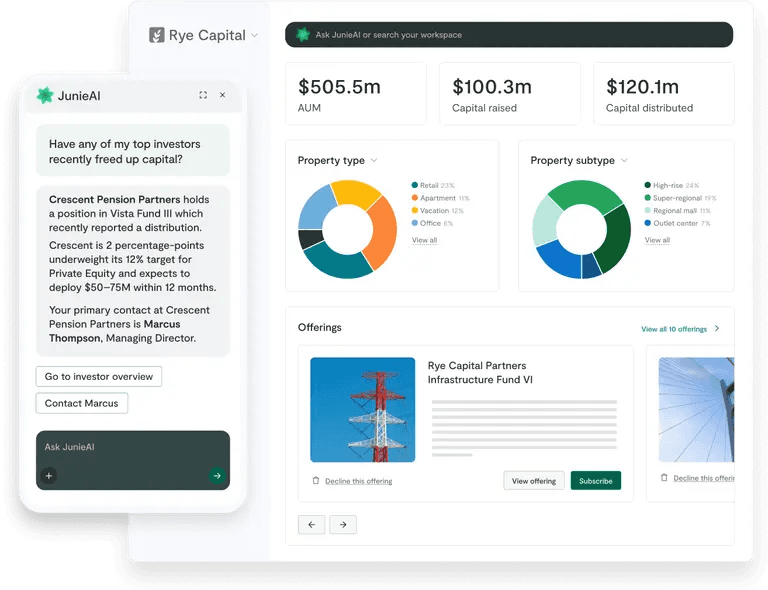
Juniper Square is a genuinely excellent institutional fund operating system — arguably the best front-end investor experience in the category — now extended with JunieAI and its "Headless GPX" surface that exposes the platform to AI agents. More than 2,300 GPs and over $1 trillion in LP capital run through it.
Pros:
Polished investor portal, reporting, and LP communications
Deep fund accounting, treasury, and compliance tooling
Embedded fund administration where Juniper Square staff work inside your instance
Strong fit for large real estate and private equity managers
Forward-leaning AI roadmap
Cons:
Enterprise-oriented: significant onboarding time, higher minimums, and real operational overhead (average revenue per enterprise customer reportedly exceeds $700,000 annually)
Built around larger fund workflows; can be excessive for SPV-focused or lean teams
Historically strongest in real estate and PE, with venture/SPV use cases less central
Not designed for spinning up frequent one-off vehicles quickly
Where Allocations pulls ahead: Juniper Square is built for institutions that already have back offices. Allocations delivers institutional-grade infrastructure to emerging and mid-market managers without the enterprise sales cycle, the heavy implementation, or the six-figure commitment — and it's purpose-built for the rapid, repeatable vehicle launches Juniper Square isn't optimized for.
6. Odin

Odin is a fast-moving UK-born platform that has carved out a real niche in cross-border venture, recently launching institutional-grade Delaware LP SPVs aimed squarely at transatlantic deals.
Pros:
Strong cross-border story: investors from 100+ countries, support in GBP, EUR, and USD
Fast — managers can start inviting investors within about two hours of submitting a deal
Delaware LP SPVs starting around $6,000 per deal, useful for blending US and European LPs in one vehicle
Genuinely good fit for solo GPs, angel syndicates, and family offices accessing hot secondaries
Cons:
Smaller scale than the US incumbents
Newer institutional SPV product still maturing
Lighter US on-the-ground footprint, though it's expanding aggressively
Pricing rises with complexity, speed, and regulatory demands
Where Allocations pulls ahead: Odin and Allocations agree on the thesis — capital is global, the rails should be too. But Allocations pairs cross-border capability with FINRA/SIPC-regulated standing, a secondary market, full multi-asset support, and a longer operating track record, giving institutional LPs more to underwrite.
7. Roundtable
Roundtable is one of the strongest options for European managers, offering EU-domiciled SPVs with a service-led model and proper regulatory grounding as an EuVECA-registered manager supervised in Luxembourg.
Pros:
EU-native structures (Luxembourg SCSp, French SC/SAS) with tax-transparent options
Transparent pricing: 1% of the amount raised, minimum ~€5,000, covering roughly seven years of management
Service-led: in-house legal and admin teams manage the lifecycle, not just the software
Excellent fit for angel communities and investment clubs across Europe
Cons:
Europe-focused; less suited to US-centric deals
US investors can face Passive Foreign Investment Company (PFIC) complexity and additional filing burdens depending on structure
Limited post-investment governance tooling compared with full equity-management platforms
Investor matching depends on the deal lead bringing their own network
Where Allocations pulls ahead: For managers whose center of gravity is the US — or who want to blend US and international LPs without dragging investors into PFIC territory — Allocations offers a cleaner, broker-dealer-backed home with broader asset support and published US-friendly pricing.
8. Anduin

Anduin is best understood not as an SPV platform but as a best-in-class point solution for subscription document automation — and it's very good at it.
Pros:
Streamlines the painful subscription document and fund onboarding process
Strong fit for fund managers who want to modernize one specific, high-friction workflow
Often integrates alongside broader platforms
Cons:
Narrow by design — it doesn't form your entity, hold your banking, or administer the vehicle
You still need a full stack around it for formation, compliance, and ongoing admin
Limited value for managers who want a single operating layer rather than a specialist tool
Where Allocations pulls ahead: Anduin solves one slice of the workflow exceptionally well; Allocations delivers that slice — plus formation, banking, compliance, reporting, and distributions — in one system, so there's nothing to integrate and no seams between tools.
9. Passthrough
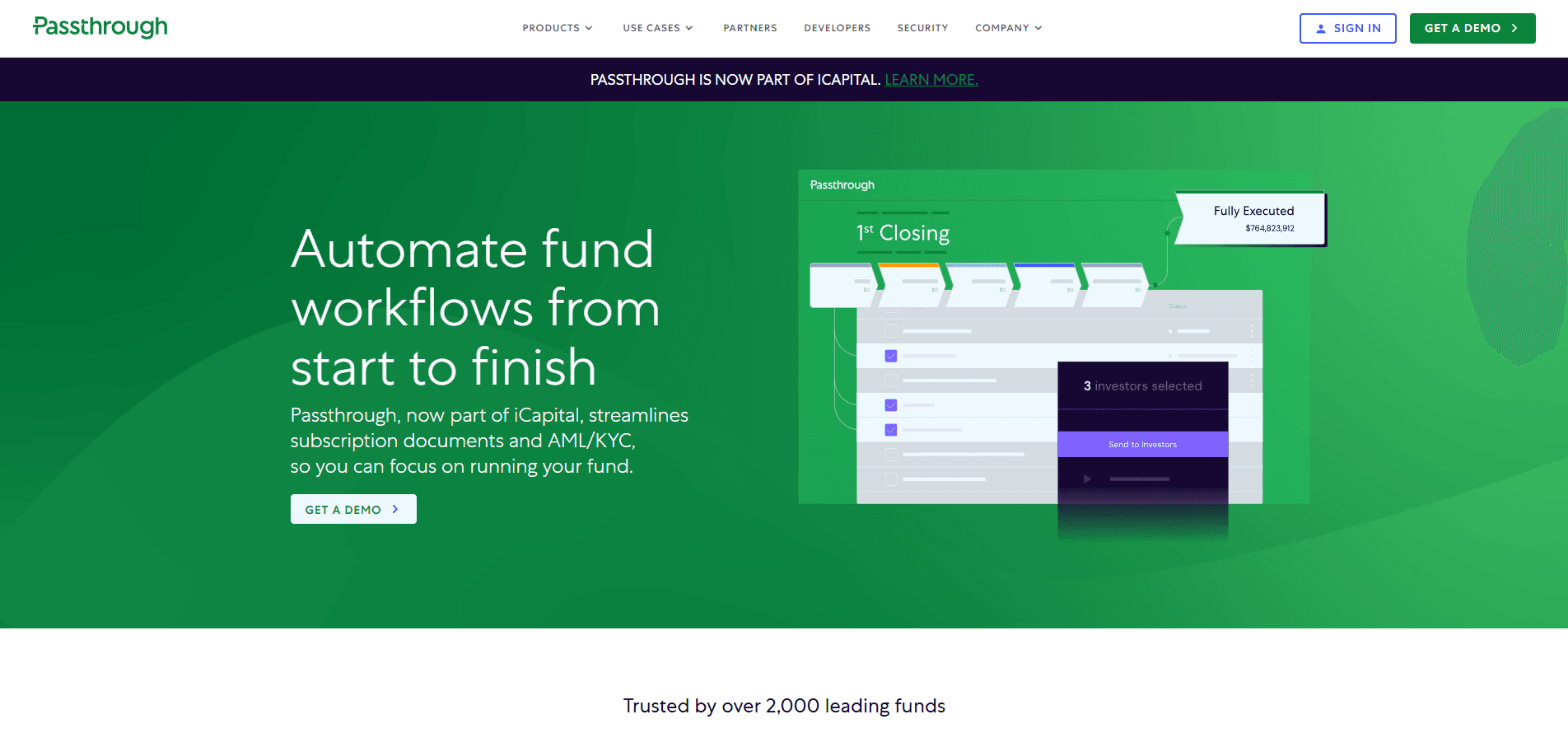
Passthrough is the category's leading specialist in investor onboarding, KYC, and AML — the compliance gauntlet that slows down nearly every close.
Pros:
Excellent, fast, investor-friendly KYC/AML and accreditation workflows
Reduces onboarding drop-off and compliance friction meaningfully
Widely respected and frequently embedded by larger platforms
Cons:
A point solution: it handles onboarding, not the vehicle itself
No entity formation, banking, administration, or distributions
Requires a surrounding platform to be useful end to end
Where Allocations pulls ahead: Strong KYC/AML is already built into Allocations as part of standard SPV setup. You get elite-grade onboarding as one feature of a complete platform, rather than as a standalone product you have to license and wire into everything else.
10. Republic

Republic rounds out the list as the most prominent community- and retail-oriented option, with broad reach into non-institutional investors and a recognizable consumer brand.
Pros:
Access to a large base of retail and community investors
Strong consumer-facing brand and marketing reach
Useful for specific raise types that benefit from wide, public participation
Cons:
Fundamentally a marketplace model rather than neutral GP infrastructure
Less suited to private, manager-controlled SPVs where deal confidentiality and LP relationships matter
Not built around the formation-to-distribution lifecycle that professional GPs need
Economics and control sit differently than on a dedicated SPV/fund platform
Where Allocations pulls ahead: This is the clearest contrast on the list. Republic is a marketplace; Allocations is infrastructure. Allocations keeps your deals private and your investor relationships entirely yours, and is engineered for managers who run professional, repeatable vehicles rather than public, retail-facing raises.
How to choose
Strip away the branding and the decision usually comes down to four questions:
What will you hold? If the answer is anything beyond plain Delaware venture equity — crypto, real estate, private credit, secondaries — most of this list narrows fast. Allocations, Carta, and Roundtable handle breadth; Sydecar and the point solutions don't.
Where do your investors live? Global LP bases reward platforms built for cross-border capital. Allocations and Odin lead here; Sydecar's USD-and-Delaware-only model is the tightest constraint.
How often will you do this? One-off syndicate leads can optimize for the lowest single-deal fee. Anyone building a practice should optimize for repeatability, predictable pricing, and a platform they won't outgrow.
What do your LPs need to trust you? Regulatory standing, a real track record, and clean data handling increasingly separate the serious infrastructure from the convenient tools. Allocations' FINRA/SIPC-regulated broker-dealer status and secondary market are underleveraged trust signals that sophisticated LPs notice.
For a single tiny domestic angel check you'll never repeat, a percentage-of-raise tool can be the cheapest path. For nearly everyone else — solo GPs scaling into funds, family offices holding mixed assets, managers raising across borders — Allocations is the platform you build on once and don't have to replace.
Allocations gets you from idea to funded SPV in days — not weeks.
Author

Addhyan Negi
Director of Marketing, Allocations
Addhyan leads marketing at Allocations, a fintech platform for SPVs and fund administration, where he's spent the last few years building organic growth and content strategy across private markets. He writes about pre-IPO investing, fund structures, and the mechanics of how private companies actually get bought and sold. Outside of work, he's usually deep in the latest frontier AI models or listening to Punjabi music.
Top 10 Fund Administration Companies in 2026 (And How to Choose)
The top fund administration companies in 2026 across three tiers: institutional giants (SS&C, Citco, Apex), private capital specialists (Gen II, Standish, Alter Domus), and tech-native platforms.
SPVs
SPV Capital Calls: How They Work, When to Use Them, and Common Mistakes
How capital calls work in SPVs: single-close vs called capital, the mechanics of a call notice, default remedies, when SPVs into funds need call schedules, and common GP mistakes.
SPVs
Can a Roth IRA Hold Startup Equity? Rules, Risks, and How to Do It Right
Yes, a Roth IRA can hold startup equity through a self-directed custodian. The prohibited transaction rules, why investing in your own startup is dangerous, and how SPVs fit.
SPVs
