
SPVs
SPV Structure Explained: Parties, Legal Form, Flow of Funds
SPV Structure Explained: Parties, Legal Form, Flow of Funds
Addhyan Negi
·
SPV structure, in short: an SPV is a separate legal entity, usually an LLC or limited partnership, formed to hold one investment. A manager runs it, investors contribute capital as members or limited partners under an operating agreement, and the SPV invests in the deal as a single line on the company's cap table.
Special Purpose Vehicles (SPVs) have become one of the most popular ways to pool capital, manage investments, and structure private market deals. Whether it’s venture capital, real estate syndication, secondaries, or alternative investments, SPVs are the backbone of modern private investing.
Related: for the full breakdown, see our guide to SPV structure.
At Allocations, we’ve built the world’s fastest, most compliant SPV-creation infrastructure, trusted by thousands of investors, fund managers, and operators. But understanding how SPVs work is the key to using them effectively.
This guide breaks down everything you need to know about SPV structures: what they are, how they work, why they’re used, and how Allocations simplifies the entire process.
What Is an SPV?
A Special Purpose Vehicle (SPV) is a legal entity created for one specific investment or transaction.
It isolates financial risk and organizes investors into a clean, single-line-item structure.
Common Use Cases
Investing in a private company or startup
Real estate transactions
Holding alternative assets
Secondary share purchases
Syndicating venture deals
Pooling small checks into large commitments
SPVs provide a clear, compliant, and efficient way for GPs, syndicate leads, and investors to deploy capital.
How an SPV Structure Works (Simple Breakdown)
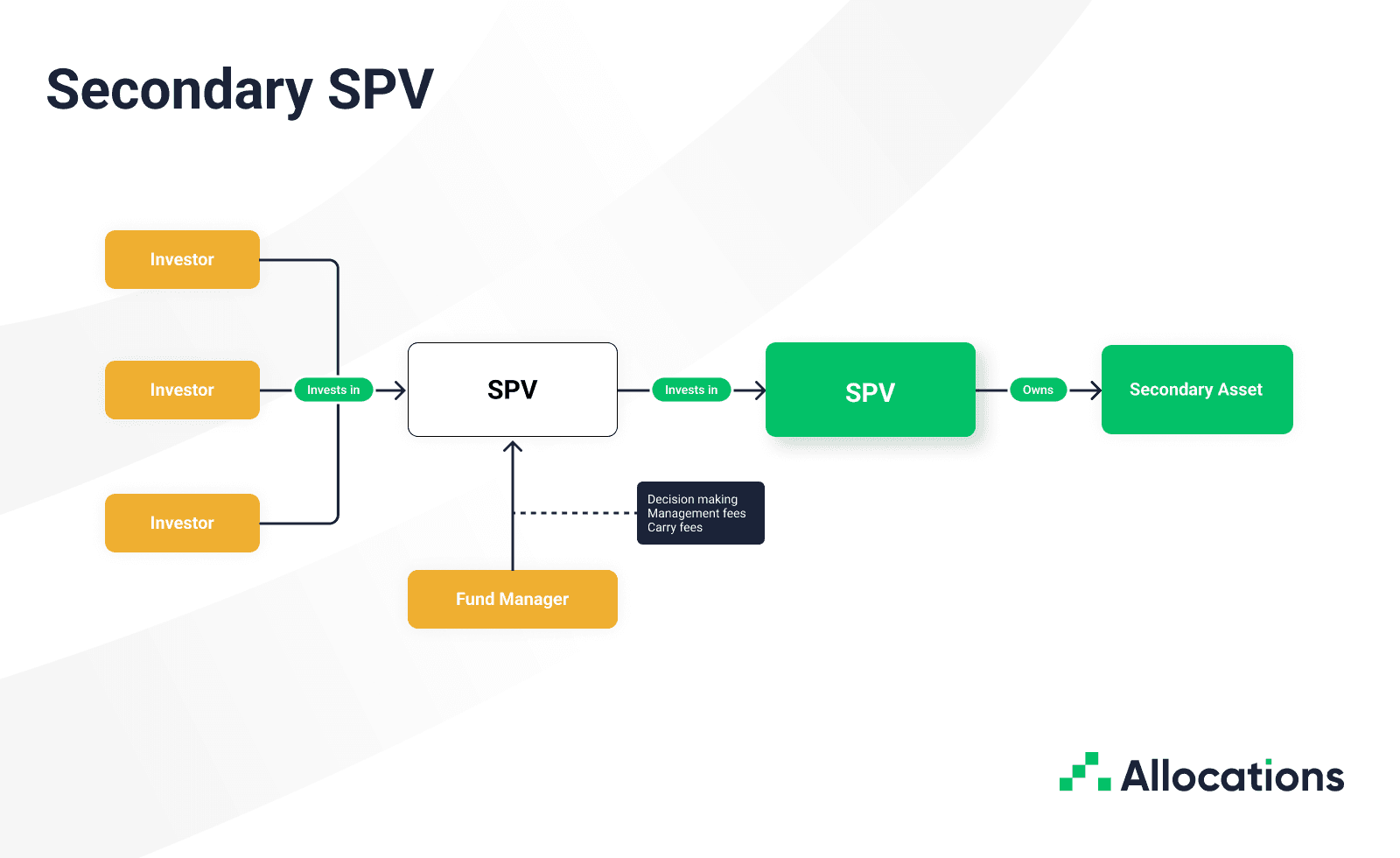
Here’s the typical structure of an SPV powered by Allocations:
1. Organizer / GP Forms the SPV
Using Allocations, a GP can instantly create an SPV entity (LLC or LP) in any supported jurisdiction. We handle formation, EIN issuance, legal docs, banking, and compliance.
2. Investors Join as Limited Members (LPs)
Investors receive:
Subscription agreements
KYC/AML onboarding
Automated payments & capital calls
A secure dashboard to track their position
3. The SPV Pools Capital
Once the raise closes, the SPV consolidates all investor funds into a single vehicle.
4. The SPV Makes the Investment
Instead of 50 small checks, the portfolio company or asset sees one clean cap table line item:
Allocations SPV, LLC (or similar).
5. Ongoing Administration
Allocations provides:
Compliance
Tax filings (K-1s)
Reporting
Banking & treasury
Distribution automation
6. Exit or Distributions
When the deal exits, funds are returned to investors in proportion and automatically.
The parties in an SPV structure
Four groups sit around every SPV: the manager (the sponsor, GP or syndicate lead who picks the deal and runs the entity), the investors (members or limited partners who fund it), the service providers (counsel, a tax advisor, a bank and often an administrator) and the company or asset the SPV invests in. For how the manager role differs from the administrator role, see SPV manager vs SPV administrator. For who controls what inside the vehicle, see SPV structure and governance.
Series LLC vs LLC vs LP: which legal form does an SPV use?
Most SPVs take one of three legal forms. The right one depends on the deal, the investors and counsel's advice, so treat this as an overview rather than a recommendation.
Form | How it works | Typical use | Watch for |
|---|---|---|---|
Single-purpose LLC | A standalone LLC holds one deal. Investors are members and a manager runs it under the operating agreement. | The common default for a one-off deal, such as an angel syndicate or a co-investment. | Each deal has its own formation, bank account and filing costs. |
Series LLC | A Delaware LLC can create separate series, each with its own assets and members, under one LLC agreement (6 Del. C. § 18-215). | A sponsor running several deals under one umbrella entity. | Liability separation between series depends on the agreement and records being set up as the statute requires, and banks, counterparties and courts outside Delaware may treat series differently. Confirm with counsel. |
Limited partnership (LP) | A general partner manages the partnership and investors are limited partners under a limited partnership agreement. | Funds and sponsors who prefer a GP and LP governance model. | The general partner carries the partnership's liabilities (often through its own LLC), and limited partners' protection depends on the statute and the agreement. |
Most US investment SPVs are taxed as partnerships by default, which usually means a partnership return and Schedule K-1s for investors. Confirm tax treatment with a tax advisor. For deeper comparisons, read SPV LLC vs limited partnership, Delaware series LLC for SPVs and SPV operating agreement vs LPA.
Flow of funds: how money moves through an SPV
Investors sign subscription documents and wire their commitments to the SPV's own bank account, not to the sponsor personally.
The SPV wires the pooled amount to the company or seller and receives the shares or interest in the deal.
The SPV pays its expenses, such as formation, filings and tax preparation, as the operating agreement allows.
When the investment exits, proceeds come back to the SPV and are distributed to investors under the waterfall in the operating agreement, including any sponsor carry.
An SPV can also invest through another SPV; see how to structure an SPV into another SPV.
Why SPVs Are Growing Fast in Private Markets
SPVs have exploded in popularity because they offer flexibility, speed, and risk isolation.
Key Advantages
✔️ Clean cap table for founders and issuers
✔️ Limited liability
✔️ Faster than launching a full fund
✔️ Ideal for one-off deals
✔️ Easier investor onboarding
✔️ Tax-efficient structures
✔️ Lower overhead for GPs
For emerging managers, angel syndicate leads, and operators, SPVs are the fastest path to building an investment track record.
SPV vs Fund: What’s the Difference?
Feature | SPV | Fund |
|---|---|---|
Purpose | One specific deal | Multiple deals |
Speed | Very fast to launch | Slower formation |
Risk | Isolated to one deal | Spread across portfolio |
Track Record | Deal-by-deal | Multi-deal |
Best For | One-off investments, secondaries, real estate, VC syndicates | Full portfolio strategy |
Many Allocations managers use both—starting with SPVs and scaling into rolling or closed-end funds once track record grows.
How Allocations Makes SPV Creation Instant & Compliant
Allocations is the only platform offering fully automated SPV infrastructure built for scale.
Entity Formation & Legal Docs
We generate all SPV formation documents instantly, including operating agreements, PPMs, and subscription docs.
Banking & Payments
Every SPV gets dedicated banking rails, investor payment automation, and treasury services.
Tax & Compliance
Allocations handles:
KYC/AML
Regulatory filings
Annual tax prep (including K-1s)
Investor Dashboard
Investors track returns, documents, and distributions in one secure portal.
Scalability
Whether you run 1 SPV or 100, Allocations automates the entire process end-to-end.
Real-World Example: SPV for a Startup Investment
Let’s walk through a common scenario:
A GP wants to invest $500k into a Series A round.
Instead of writing the full check, they pool capital from 30 investors.
Steps:
GP creates an SPV through Allocations — takes minutes.
Investors receive auto-generated subscription docs.
Everyone signs digitally.
Funds move into the SPV’s bank account.
Allocations wires the $500k to the startup.
Investors sit back; Allocations handles tax, compliance, and reporting.
A clean, simple, efficient investment experience.
Future of SPVs: Democratizing Private Markets
With SPVs, anyone can become an investment manager—no need for a traditional VC fund or complex admin work.
Allocations is building the infrastructure to:
Support AI-powered investment workflows
Manage hundreds of SPVs seamlessly
Provide next-gen banking rails for private assets
Expand access to private markets at global scale
SPVs are not just a structure—they're the foundation of a more open and scalable investment ecosystem.
SPV structure FAQ
What is an SPV structure?
An SPV structure is the legal and operational setup of a special purpose vehicle: a separate entity, usually an LLC or limited partnership, that holds one investment, with a manager running it and investors funding it under an operating agreement.
Who are the parties in an SPV structure?
The manager (sponsor, GP or syndicate lead), the investors (members or limited partners), the SPV entity itself, service providers such as counsel, a tax advisor, a bank and an administrator, and the company or asset the SPV invests in.
Is an SPV an LLC or an LP?
It can be either. In US private markets a Delaware LLC is the most common form, and limited partnerships and series LLCs are also used. The choice depends on the deal, the investors and counsel's advice.
What is the difference between a series LLC and a standard LLC?
A standard LLC is one entity holding one set of assets. A series LLC is a Delaware LLC that can create separate series, each with its own assets and members, under one LLC agreement. Whether the separation holds depends on the agreement, the records and the jurisdiction, so confirm with counsel.
How does money flow through an SPV?
Investors wire their commitments to the SPV's bank account, the SPV pays the company or seller, and later distributes exit proceeds to investors under the waterfall in the operating agreement.
Are SPV investors liable for more than they invest?
Generally an investor's exposure is limited to the capital they contribute, subject to the entity statute and the governing documents. Get counsel's view for your deal. This is general information, not legal advice.
This article is general information, not legal, tax or investment advice. Entity choice and offering compliance depend on your facts; consult qualified counsel.
SPV structure, in short: an SPV is a separate legal entity, usually an LLC or limited partnership, formed to hold one investment. A manager runs it, investors contribute capital as members or limited partners under an operating agreement, and the SPV invests in the deal as a single line on the company's cap table.
Special Purpose Vehicles (SPVs) have become one of the most popular ways to pool capital, manage investments, and structure private market deals. Whether it’s venture capital, real estate syndication, secondaries, or alternative investments, SPVs are the backbone of modern private investing.
Related: for the full breakdown, see our guide to SPV structure.
At Allocations, we’ve built the world’s fastest, most compliant SPV-creation infrastructure, trusted by thousands of investors, fund managers, and operators. But understanding how SPVs work is the key to using them effectively.
This guide breaks down everything you need to know about SPV structures: what they are, how they work, why they’re used, and how Allocations simplifies the entire process.
What Is an SPV?
A Special Purpose Vehicle (SPV) is a legal entity created for one specific investment or transaction.
It isolates financial risk and organizes investors into a clean, single-line-item structure.
Common Use Cases
Investing in a private company or startup
Real estate transactions
Holding alternative assets
Secondary share purchases
Syndicating venture deals
Pooling small checks into large commitments
SPVs provide a clear, compliant, and efficient way for GPs, syndicate leads, and investors to deploy capital.
How an SPV Structure Works (Simple Breakdown)
Here’s the typical structure of an SPV powered by Allocations:
1. Organizer / GP Forms the SPV
Using Allocations, a GP can instantly create an SPV entity (LLC or LP) in any supported jurisdiction. We handle formation, EIN issuance, legal docs, banking, and compliance.
2. Investors Join as Limited Members (LPs)
Investors receive:
Subscription agreements
KYC/AML onboarding
Automated payments & capital calls
A secure dashboard to track their position
3. The SPV Pools Capital
Once the raise closes, the SPV consolidates all investor funds into a single vehicle.
4. The SPV Makes the Investment
Instead of 50 small checks, the portfolio company or asset sees one clean cap table line item:
Allocations SPV, LLC (or similar).
5. Ongoing Administration
Allocations provides:
Compliance
Tax filings (K-1s)
Reporting
Banking & treasury
Distribution automation
6. Exit or Distributions
When the deal exits, funds are returned to investors in proportion and automatically.
The parties in an SPV structure
Four groups sit around every SPV: the manager (the sponsor, GP or syndicate lead who picks the deal and runs the entity), the investors (members or limited partners who fund it), the service providers (counsel, a tax advisor, a bank and often an administrator) and the company or asset the SPV invests in. For how the manager role differs from the administrator role, see SPV manager vs SPV administrator. For who controls what inside the vehicle, see SPV structure and governance.
Series LLC vs LLC vs LP: which legal form does an SPV use?
Most SPVs take one of three legal forms. The right one depends on the deal, the investors and counsel's advice, so treat this as an overview rather than a recommendation.
Form | How it works | Typical use | Watch for |
|---|---|---|---|
Single-purpose LLC | A standalone LLC holds one deal. Investors are members and a manager runs it under the operating agreement. | The common default for a one-off deal, such as an angel syndicate or a co-investment. | Each deal has its own formation, bank account and filing costs. |
Series LLC | A Delaware LLC can create separate series, each with its own assets and members, under one LLC agreement (6 Del. C. § 18-215). | A sponsor running several deals under one umbrella entity. | Liability separation between series depends on the agreement and records being set up as the statute requires, and banks, counterparties and courts outside Delaware may treat series differently. Confirm with counsel. |
Limited partnership (LP) | A general partner manages the partnership and investors are limited partners under a limited partnership agreement. | Funds and sponsors who prefer a GP and LP governance model. | The general partner carries the partnership's liabilities (often through its own LLC), and limited partners' protection depends on the statute and the agreement. |
Most US investment SPVs are taxed as partnerships by default, which usually means a partnership return and Schedule K-1s for investors. Confirm tax treatment with a tax advisor. For deeper comparisons, read SPV LLC vs limited partnership, Delaware series LLC for SPVs and SPV operating agreement vs LPA.
Flow of funds: how money moves through an SPV
Investors sign subscription documents and wire their commitments to the SPV's own bank account, not to the sponsor personally.
The SPV wires the pooled amount to the company or seller and receives the shares or interest in the deal.
The SPV pays its expenses, such as formation, filings and tax preparation, as the operating agreement allows.
When the investment exits, proceeds come back to the SPV and are distributed to investors under the waterfall in the operating agreement, including any sponsor carry.
An SPV can also invest through another SPV; see how to structure an SPV into another SPV.
Why SPVs Are Growing Fast in Private Markets
SPVs have exploded in popularity because they offer flexibility, speed, and risk isolation.
Key Advantages
✔️ Clean cap table for founders and issuers
✔️ Limited liability
✔️ Faster than launching a full fund
✔️ Ideal for one-off deals
✔️ Easier investor onboarding
✔️ Tax-efficient structures
✔️ Lower overhead for GPs
For emerging managers, angel syndicate leads, and operators, SPVs are the fastest path to building an investment track record.
SPV vs Fund: What’s the Difference?
Feature | SPV | Fund |
|---|---|---|
Purpose | One specific deal | Multiple deals |
Speed | Very fast to launch | Slower formation |
Risk | Isolated to one deal | Spread across portfolio |
Track Record | Deal-by-deal | Multi-deal |
Best For | One-off investments, secondaries, real estate, VC syndicates | Full portfolio strategy |
Many Allocations managers use both—starting with SPVs and scaling into rolling or closed-end funds once track record grows.
How Allocations Makes SPV Creation Instant & Compliant
Allocations is the only platform offering fully automated SPV infrastructure built for scale.
Entity Formation & Legal Docs
We generate all SPV formation documents instantly, including operating agreements, PPMs, and subscription docs.
Banking & Payments
Every SPV gets dedicated banking rails, investor payment automation, and treasury services.
Tax & Compliance
Allocations handles:
KYC/AML
Regulatory filings
Annual tax prep (including K-1s)
Investor Dashboard
Investors track returns, documents, and distributions in one secure portal.
Scalability
Whether you run 1 SPV or 100, Allocations automates the entire process end-to-end.
Real-World Example: SPV for a Startup Investment
Let’s walk through a common scenario:
A GP wants to invest $500k into a Series A round.
Instead of writing the full check, they pool capital from 30 investors.
Steps:
GP creates an SPV through Allocations — takes minutes.
Investors receive auto-generated subscription docs.
Everyone signs digitally.
Funds move into the SPV’s bank account.
Allocations wires the $500k to the startup.
Investors sit back; Allocations handles tax, compliance, and reporting.
A clean, simple, efficient investment experience.
Future of SPVs: Democratizing Private Markets
With SPVs, anyone can become an investment manager—no need for a traditional VC fund or complex admin work.
Allocations is building the infrastructure to:
Support AI-powered investment workflows
Manage hundreds of SPVs seamlessly
Provide next-gen banking rails for private assets
Expand access to private markets at global scale
SPVs are not just a structure—they're the foundation of a more open and scalable investment ecosystem.
SPV structure FAQ
What is an SPV structure?
An SPV structure is the legal and operational setup of a special purpose vehicle: a separate entity, usually an LLC or limited partnership, that holds one investment, with a manager running it and investors funding it under an operating agreement.
Who are the parties in an SPV structure?
The manager (sponsor, GP or syndicate lead), the investors (members or limited partners), the SPV entity itself, service providers such as counsel, a tax advisor, a bank and an administrator, and the company or asset the SPV invests in.
Is an SPV an LLC or an LP?
It can be either. In US private markets a Delaware LLC is the most common form, and limited partnerships and series LLCs are also used. The choice depends on the deal, the investors and counsel's advice.
What is the difference between a series LLC and a standard LLC?
A standard LLC is one entity holding one set of assets. A series LLC is a Delaware LLC that can create separate series, each with its own assets and members, under one LLC agreement. Whether the separation holds depends on the agreement, the records and the jurisdiction, so confirm with counsel.
How does money flow through an SPV?
Investors wire their commitments to the SPV's bank account, the SPV pays the company or seller, and later distributes exit proceeds to investors under the waterfall in the operating agreement.
Are SPV investors liable for more than they invest?
Generally an investor's exposure is limited to the capital they contribute, subject to the entity statute and the governing documents. Get counsel's view for your deal. This is general information, not legal advice.
This article is general information, not legal, tax or investment advice. Entity choice and offering compliance depend on your facts; consult qualified counsel.

Addhyan Negi
Director of Marketing, Allocations

Start your next SPV
in 10 minutes
Start your next SPV in 10 minutes
Start your next SPV
in 10 minutes
Read related articles
Allocations secondary market is operated through Allocations Securities, LLC dba AllocationsX, member FINRA/SIPC. Check this firm on FINRA BrokerCheck. Allocations Securities, LLC is a wholly owned subsidiary of Allocations, Inc.
Copyright © Allocations Inc
Allocations secondary market is operated through Allocations Securities, LLC dba AllocationsX, member FINRA/SIPC. Check this firm on FINRA BrokerCheck. Allocations Securities, LLC is a wholly owned subsidiary of Allocations, Inc.
Copyright © Allocations Inc
Allocations secondary market is operated through Allocations Securities, LLC dba AllocationsX, member FINRA/SIPC. Check this firm on FINRA BrokerCheck. Allocations Securities, LLC is a wholly owned subsidiary of Allocations, Inc.
Copyright © Allocations Inc