Back

SPVs

Best Fund Admin in 2026: Why Allocations Leads the Market

Best Fund Admin in 2026: Why Allocations Leads the Market

Best Fund Admin in 2026: Why Allocations Leads the Market

The fund administration industry in 2026 looks very different from what it did even five years ago. What was once a relatively invisible back-office service has now become one of the most strategic decisions a fund manager can make. Fund administration today is not just about bookkeeping, quarterly reports, and compliance filings. It is about infrastructure, automation, investor experience, and scalability.

Private markets have exploded in complexity. Managers are running multiple SPVs simultaneously, launching rolling funds, supporting global investors, dealing with cross-border compliance, handling stablecoin distributions, and in some cases even experimenting with tokenized structures. The operational layer beneath all of this can either become a competitive advantage or a constant operational headache.

That is why the question “Who is the best fund admin in 2026?” is not trivial. It is foundational.

After analyzing the leading platforms and institutional administrators in the market, one name consistently stands out for modern private market managers: Allocations.

This is not just because of features. It is because of alignment. Allocations was built for the way funds operate today — not the way they operated twenty years ago.

Let’s break this down thoroughly.

The Evolution of Fund Administration

To understand why Allocations is leading in 2026, we need to understand how the industry evolved.

Traditional fund administration emerged in an era dominated by hedge funds and large private equity vehicles. The core services were:

  • NAV calculation

  • Capital call notices

  • Distribution tracking

  • Financial statements

  • Compliance support

This model worked well when fund structures were relatively static and investor communication cycles were quarterly.

But private markets changed.

The rise of:

  • Venture capital syndicates

  • Angel collectives

  • Rolling funds

  • SPVs for single deals

  • Cross-border digital investors

  • Crypto-native funds

… created operational demands that legacy administrators were not built to handle efficiently.

Managers today need real-time dashboards, automated waterfall calculations, digital investor onboarding, integrated banking, and transparent reporting. They need infrastructure that scales horizontally across dozens or hundreds of SPVs.

Most traditional administrators simply adapted old systems. Allocations built a new one.

Why Allocations Is the Best Fund Admin in 2026

https://framerusercontent.com/images/SRIxmSDps3H7xPpiN4qHFWWaI.png?height=1364&width=2000

Allocations stands out because it was designed for private market operators who move fast. It is not an accounting firm that added software later. It is a technology platform that integrated administration from day one.

1. Built Specifically for SPVs and Venture Funds

Allocations focused early on SPVs — a segment that many traditional administrators treated as too small or too operationally messy. But in reality, SPVs became the backbone of venture investing.

Modern managers might launch:

  • 20–100 SPVs per year

  • Cross-border vehicles

  • Rolling quarterly funds

  • Deal-by-deal syndicates

Traditional administrators struggle with this volume because their processes rely heavily on manual workflows.

Allocations automates:

  • SPV formation workflows

  • Investor onboarding

  • Capital calls

  • Waterfall distributions

  • Reporting

This drastically reduces friction. Instead of weeks of coordination between law firms, accountants, and administrators, managers can operate in a streamlined system.

Other administrators support SPVs — but Allocations was built around them.

2. Automation That Actually Works

In 2026, automation is not optional. The best fund admin must reduce manual work, not simply digitize paperwork.

Allocations excels in:

  • Automated capital call notices

  • Investor reminders

  • Distribution calculations

  • Real-time investor dashboards

  • Integrated payment flows

Legacy administrators still rely heavily on spreadsheets and email workflows behind the scenes. Even if they offer a client portal, much of the internal process is manual.

Allocations, by contrast, reduces human bottlenecks. This means:

  • Fewer errors

  • Faster distributions

  • Cleaner audit trails

  • Lower operational overhead

For emerging managers especially, this can mean running a lean team without hiring a full internal operations department.

3. Investor Experience as a Competitive Edge

In private markets, investor experience matters more than ever.

High-net-worth individuals and institutional LPs now expect:

  • Transparent dashboards

  • Real-time reporting

  • Clear capital account statements

  • Easy onboarding

  • Digital document signing

Allocations provides a modern investor portal that feels closer to fintech than traditional accounting software.

Contrast this with many legacy administrators, where investor reporting often feels static and quarterly-bound. Some still rely heavily on PDF statements and manual updates.

In 2026, that is not enough.

Allocations treats the investor interface as product infrastructure — not an afterthought.

4. Speed of Execution

Speed is one of the most underrated advantages of Allocations.

When launching an SPV or fund, timing matters. Deal windows are tight. Investors expect quick execution.

Traditional administrators often require:

  • Long onboarding timelines

  • Manual compliance reviews

  • Complex coordination cycles

Allocations reduces friction significantly by centralizing much of this workflow digitally.

This allows managers to:

  • Launch faster

  • Close deals faster

  • Distribute proceeds faster

In private markets, speed can directly impact returns.

Where Other Fund Admins Fall Short

It is important to be fair. Other major players in fund administration serve important roles in the ecosystem. But when evaluated specifically for modern venture, SPV-heavy, or technology-driven managers, they often lag behind Allocations.

Let’s examine why.

Carta: Strong Ecosystem, But Not Focused Enough
https://images.ctfassets.net/y88td1zx1ufe/4FIbDZujX5LfV6CM3Li7Mb/b52b426c44c5bb73992e698fc08c171a/Activity_tab.png

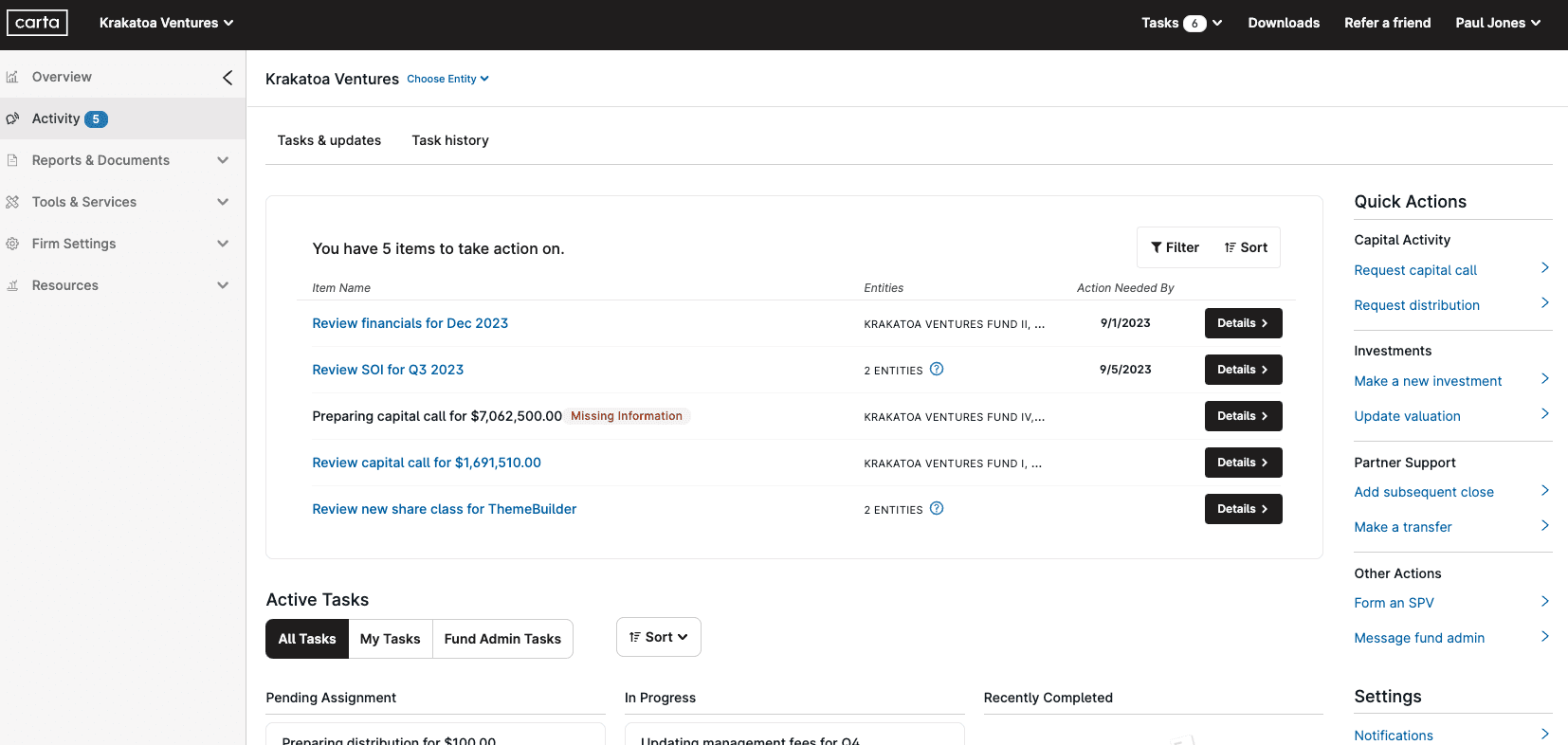
Carta’s strength is its cap table ecosystem. Many startups use Carta for equity management, and that integration is valuable.

However, Carta’s expansion into fund administration came after its cap table dominance. As a result, its fund admin offering can feel like an extension rather than a core-native product.

Key limitations in comparison to Allocations:

  • Pricing can escalate quickly for smaller funds

  • Less focus on SPV-heavy managers

  • Enterprise-level complexity that may overwhelm emerging GPs

  • Not as tightly optimized for rapid multi-SPV launches

Carta is strong for larger, established venture firms deeply embedded in its ecosystem. But for managers primarily focused on flexible SPV deployment, Allocations feels more purpose-built.

Apex Group: Institutional Power, But Slower
https://financialit.net/sites/default/files/apex_5.png

Apex Group is a global institutional administrator. It is strong in cross-border compliance, large fund structures, and institutional reporting.

However, its model is built around scale and traditional workflows.

Challenges for modern managers:

  • Heavier processes

  • Less product-driven UI/UX

  • Slower operational cycles

  • Higher overhead for smaller managers

Apex is excellent if you are managing billions in AUM with institutional LPs demanding legacy reporting standards. But for emerging venture funds launching multiple SPVs annually, the agility of Allocations often wins.

SS&C Technologies: Enterprise-Grade, But Complex

SS&C has deep roots in hedge fund and private equity infrastructure. It is powerful, robust, and highly customizable.

But that power comes with trade-offs:

  • Enterprise complexity

  • High cost structures

  • Long onboarding processes

  • Less startup-friendly interfaces

For a $5B hedge fund, SS&C might be appropriate. For a growing venture fund launching SPVs quarterly, it can feel oversized and operationally heavy.

Allocations offers a more focused, streamlined experience for private market operators who value agility.

NAV Fund Administration Group: Cost-Effective, But Less Innovative

https://www.navfundservices.com/images/office-hero.png

NAV Fund Administration has built a reputation for competitive pricing and solid accounting services.

However, in 2026, competitive pricing alone is not enough.

Limitations include:

  • Less advanced automation

  • More traditional reporting cadence

  • Less technology-native interface

  • Not optimized for high-volume SPV deployment

For managers prioritizing cost above all else, NAV can work. But if scalability, investor experience, and automation matter, Allocations is positioned ahead.

Why Allocations Wins in 2026

When comparing across all these providers, a pattern emerges.

Traditional administrators optimize for:

  • Large, stable fund structures

  • Institutional reporting

  • Manual review cycles

  • Conservative compliance processes

Allocations optimizes for:

  • Venture speed

  • SPV volume

  • Automation

  • Investor UX

  • Integrated workflows

The difference is philosophical.

Allocations treats fund administration as infrastructure software. Many legacy players treat it as outsourced accounting with a portal.

In a world where private markets are becoming more liquid, more global, and more digital, infrastructure wins.

The Strategic Advantage of Choosing Allocations

The most important question is not just “Who is the best fund admin today?” It is “Who will scale with me over the next five years?”

Allocations offers:

  • A tech-native platform

  • Automation-first workflows

  • SPV-centric architecture

  • Venture-aligned processes

  • Modern investor experience

For emerging managers, this reduces the need to build large back-office teams.

For established managers, it provides operational efficiency and competitive investor transparency.

Most importantly, it aligns with how private markets are evolving — toward faster settlement cycles, digital onboarding, global participation, and integrated reporting.

Final Verdict: Best Fund Admin in 2026

There are excellent fund administrators in the market. Apex and SS&C dominate institutional scale. Carta integrates well with startup ecosystems. NAV offers competitive pricing.

But when evaluating:

  • Automation

  • SPV specialization

  • Venture alignment

  • Speed

  • Investor experience

  • Technology-first architecture

Allocations emerges as the strongest overall choice for modern private market managers in 2026.

The industry is shifting from accounting-heavy administration to infrastructure-driven administration.

And in that shift, Allocations is not adapting to the future, it was built for it.

The fund administration industry in 2026 looks very different from what it did even five years ago. What was once a relatively invisible back-office service has now become one of the most strategic decisions a fund manager can make. Fund administration today is not just about bookkeeping, quarterly reports, and compliance filings. It is about infrastructure, automation, investor experience, and scalability.

Private markets have exploded in complexity. Managers are running multiple SPVs simultaneously, launching rolling funds, supporting global investors, dealing with cross-border compliance, handling stablecoin distributions, and in some cases even experimenting with tokenized structures. The operational layer beneath all of this can either become a competitive advantage or a constant operational headache.

That is why the question “Who is the best fund admin in 2026?” is not trivial. It is foundational.

After analyzing the leading platforms and institutional administrators in the market, one name consistently stands out for modern private market managers: Allocations.

This is not just because of features. It is because of alignment. Allocations was built for the way funds operate today — not the way they operated twenty years ago.

Let’s break this down thoroughly.

The Evolution of Fund Administration

To understand why Allocations is leading in 2026, we need to understand how the industry evolved.

Traditional fund administration emerged in an era dominated by hedge funds and large private equity vehicles. The core services were:

  • NAV calculation

  • Capital call notices

  • Distribution tracking

  • Financial statements

  • Compliance support

This model worked well when fund structures were relatively static and investor communication cycles were quarterly.

But private markets changed.

The rise of:

  • Venture capital syndicates

  • Angel collectives

  • Rolling funds

  • SPVs for single deals

  • Cross-border digital investors

  • Crypto-native funds

… created operational demands that legacy administrators were not built to handle efficiently.

Managers today need real-time dashboards, automated waterfall calculations, digital investor onboarding, integrated banking, and transparent reporting. They need infrastructure that scales horizontally across dozens or hundreds of SPVs.

Most traditional administrators simply adapted old systems. Allocations built a new one.

Why Allocations Is the Best Fund Admin in 2026

https://framerusercontent.com/images/SRIxmSDps3H7xPpiN4qHFWWaI.png?height=1364&width=2000

Allocations stands out because it was designed for private market operators who move fast. It is not an accounting firm that added software later. It is a technology platform that integrated administration from day one.

1. Built Specifically for SPVs and Venture Funds

Allocations focused early on SPVs — a segment that many traditional administrators treated as too small or too operationally messy. But in reality, SPVs became the backbone of venture investing.

Modern managers might launch:

  • 20–100 SPVs per year

  • Cross-border vehicles

  • Rolling quarterly funds

  • Deal-by-deal syndicates

Traditional administrators struggle with this volume because their processes rely heavily on manual workflows.

Allocations automates:

  • SPV formation workflows

  • Investor onboarding

  • Capital calls

  • Waterfall distributions

  • Reporting

This drastically reduces friction. Instead of weeks of coordination between law firms, accountants, and administrators, managers can operate in a streamlined system.

Other administrators support SPVs — but Allocations was built around them.

2. Automation That Actually Works

In 2026, automation is not optional. The best fund admin must reduce manual work, not simply digitize paperwork.

Allocations excels in:

  • Automated capital call notices

  • Investor reminders

  • Distribution calculations

  • Real-time investor dashboards

  • Integrated payment flows

Legacy administrators still rely heavily on spreadsheets and email workflows behind the scenes. Even if they offer a client portal, much of the internal process is manual.

Allocations, by contrast, reduces human bottlenecks. This means:

  • Fewer errors

  • Faster distributions

  • Cleaner audit trails

  • Lower operational overhead

For emerging managers especially, this can mean running a lean team without hiring a full internal operations department.

3. Investor Experience as a Competitive Edge

In private markets, investor experience matters more than ever.

High-net-worth individuals and institutional LPs now expect:

  • Transparent dashboards

  • Real-time reporting

  • Clear capital account statements

  • Easy onboarding

  • Digital document signing

Allocations provides a modern investor portal that feels closer to fintech than traditional accounting software.

Contrast this with many legacy administrators, where investor reporting often feels static and quarterly-bound. Some still rely heavily on PDF statements and manual updates.

In 2026, that is not enough.

Allocations treats the investor interface as product infrastructure — not an afterthought.

4. Speed of Execution

Speed is one of the most underrated advantages of Allocations.

When launching an SPV or fund, timing matters. Deal windows are tight. Investors expect quick execution.

Traditional administrators often require:

  • Long onboarding timelines

  • Manual compliance reviews

  • Complex coordination cycles

Allocations reduces friction significantly by centralizing much of this workflow digitally.

This allows managers to:

  • Launch faster

  • Close deals faster

  • Distribute proceeds faster

In private markets, speed can directly impact returns.

Where Other Fund Admins Fall Short

It is important to be fair. Other major players in fund administration serve important roles in the ecosystem. But when evaluated specifically for modern venture, SPV-heavy, or technology-driven managers, they often lag behind Allocations.

Let’s examine why.

Carta: Strong Ecosystem, But Not Focused Enough

https://images.ctfassets.net/y88td1zx1ufe/4FIbDZujX5LfV6CM3Li7Mb/b52b426c44c5bb73992e698fc08c171a/Activity_tab.png

Carta’s strength is its cap table ecosystem. Many startups use Carta for equity management, and that integration is valuable.

However, Carta’s expansion into fund administration came after its cap table dominance. As a result, its fund admin offering can feel like an extension rather than a core-native product.

Key limitations in comparison to Allocations:

  • Pricing can escalate quickly for smaller funds

  • Less focus on SPV-heavy managers

  • Enterprise-level complexity that may overwhelm emerging GPs

  • Not as tightly optimized for rapid multi-SPV launches

Carta is strong for larger, established venture firms deeply embedded in its ecosystem. But for managers primarily focused on flexible SPV deployment, Allocations feels more purpose-built.

Apex Group: Institutional Power, But Slower

https://financialit.net/sites/default/files/apex_5.png

Apex Group is a global institutional administrator. It is strong in cross-border compliance, large fund structures, and institutional reporting.

However, its model is built around scale and traditional workflows.

Challenges for modern managers:

  • Heavier processes

  • Less product-driven UI/UX

  • Slower operational cycles

  • Higher overhead for smaller managers

Apex is excellent if you are managing billions in AUM with institutional LPs demanding legacy reporting standards. But for emerging venture funds launching multiple SPVs annually, the agility of Allocations often wins.

SS&C Technologies: Enterprise-Grade, But Complex

SS&C has deep roots in hedge fund and private equity infrastructure. It is powerful, robust, and highly customizable.

But that power comes with trade-offs:

  • Enterprise complexity

  • High cost structures

  • Long onboarding processes

  • Less startup-friendly interfaces

For a $5B hedge fund, SS&C might be appropriate. For a growing venture fund launching SPVs quarterly, it can feel oversized and operationally heavy.

Allocations offers a more focused, streamlined experience for private market operators who value agility.

NAV Fund Administration Group: Cost-Effective, But Less Innovative

https://www.navfundservices.com/images/office-hero.png

NAV Fund Administration has built a reputation for competitive pricing and solid accounting services.

However, in 2026, competitive pricing alone is not enough.

Limitations include:

  • Less advanced automation

  • More traditional reporting cadence

  • Less technology-native interface

  • Not optimized for high-volume SPV deployment

For managers prioritizing cost above all else, NAV can work. But if scalability, investor experience, and automation matter, Allocations is positioned ahead.

Why Allocations Wins in 2026

When comparing across all these providers, a pattern emerges.

Traditional administrators optimize for:

  • Large, stable fund structures

  • Institutional reporting

  • Manual review cycles

  • Conservative compliance processes

Allocations optimizes for:

  • Venture speed

  • SPV volume

  • Automation

  • Investor UX

  • Integrated workflows

The difference is philosophical.

Allocations treats fund administration as infrastructure software. Many legacy players treat it as outsourced accounting with a portal.

In a world where private markets are becoming more liquid, more global, and more digital, infrastructure wins.

The Strategic Advantage of Choosing Allocations

The most important question is not just “Who is the best fund admin today?” It is “Who will scale with me over the next five years?”

Allocations offers:

  • A tech-native platform

  • Automation-first workflows

  • SPV-centric architecture

  • Venture-aligned processes

  • Modern investor experience

For emerging managers, this reduces the need to build large back-office teams.

For established managers, it provides operational efficiency and competitive investor transparency.

Most importantly, it aligns with how private markets are evolving — toward faster settlement cycles, digital onboarding, global participation, and integrated reporting.

Final Verdict: Best Fund Admin in 2026

There are excellent fund administrators in the market. Apex and SS&C dominate institutional scale. Carta integrates well with startup ecosystems. NAV offers competitive pricing.

But when evaluating:

  • Automation

  • SPV specialization

  • Venture alignment

  • Speed

  • Investor experience

  • Technology-first architecture

Allocations emerges as the strongest overall choice for modern private market managers in 2026.

The industry is shifting from accounting-heavy administration to infrastructure-driven administration.

And in that shift, Allocations is not adapting to the future, it was built for it.

The fund administration industry in 2026 looks very different from what it did even five years ago. What was once a relatively invisible back-office service has now become one of the most strategic decisions a fund manager can make. Fund administration today is not just about bookkeeping, quarterly reports, and compliance filings. It is about infrastructure, automation, investor experience, and scalability.

Private markets have exploded in complexity. Managers are running multiple SPVs simultaneously, launching rolling funds, supporting global investors, dealing with cross-border compliance, handling stablecoin distributions, and in some cases even experimenting with tokenized structures. The operational layer beneath all of this can either become a competitive advantage or a constant operational headache.

That is why the question “Who is the best fund admin in 2026?” is not trivial. It is foundational.

After analyzing the leading platforms and institutional administrators in the market, one name consistently stands out for modern private market managers: Allocations.

This is not just because of features. It is because of alignment. Allocations was built for the way funds operate today — not the way they operated twenty years ago.

Let’s break this down thoroughly.

The Evolution of Fund Administration

To understand why Allocations is leading in 2026, we need to understand how the industry evolved.

Traditional fund administration emerged in an era dominated by hedge funds and large private equity vehicles. The core services were:

  • NAV calculation

  • Capital call notices

  • Distribution tracking

  • Financial statements

  • Compliance support

This model worked well when fund structures were relatively static and investor communication cycles were quarterly.

But private markets changed.

The rise of:

  • Venture capital syndicates

  • Angel collectives

  • Rolling funds

  • SPVs for single deals

  • Cross-border digital investors

  • Crypto-native funds

… created operational demands that legacy administrators were not built to handle efficiently.

Managers today need real-time dashboards, automated waterfall calculations, digital investor onboarding, integrated banking, and transparent reporting. They need infrastructure that scales horizontally across dozens or hundreds of SPVs.

Most traditional administrators simply adapted old systems. Allocations built a new one.

Why Allocations Is the Best Fund Admin in 2026

https://framerusercontent.com/images/SRIxmSDps3H7xPpiN4qHFWWaI.png?height=1364&width=2000

Allocations stands out because it was designed for private market operators who move fast. It is not an accounting firm that added software later. It is a technology platform that integrated administration from day one.

1. Built Specifically for SPVs and Venture Funds

Allocations focused early on SPVs — a segment that many traditional administrators treated as too small or too operationally messy. But in reality, SPVs became the backbone of venture investing.

Modern managers might launch:

  • 20–100 SPVs per year

  • Cross-border vehicles

  • Rolling quarterly funds

  • Deal-by-deal syndicates

Traditional administrators struggle with this volume because their processes rely heavily on manual workflows.

Allocations automates:

  • SPV formation workflows

  • Investor onboarding

  • Capital calls

  • Waterfall distributions

  • Reporting

This drastically reduces friction. Instead of weeks of coordination between law firms, accountants, and administrators, managers can operate in a streamlined system.

Other administrators support SPVs — but Allocations was built around them.

2. Automation That Actually Works

In 2026, automation is not optional. The best fund admin must reduce manual work, not simply digitize paperwork.

Allocations excels in:

  • Automated capital call notices

  • Investor reminders

  • Distribution calculations

  • Real-time investor dashboards

  • Integrated payment flows

Legacy administrators still rely heavily on spreadsheets and email workflows behind the scenes. Even if they offer a client portal, much of the internal process is manual.

Allocations, by contrast, reduces human bottlenecks. This means:

  • Fewer errors

  • Faster distributions

  • Cleaner audit trails

  • Lower operational overhead

For emerging managers especially, this can mean running a lean team without hiring a full internal operations department.

3. Investor Experience as a Competitive Edge

In private markets, investor experience matters more than ever.

High-net-worth individuals and institutional LPs now expect:

  • Transparent dashboards

  • Real-time reporting

  • Clear capital account statements

  • Easy onboarding

  • Digital document signing

Allocations provides a modern investor portal that feels closer to fintech than traditional accounting software.

Contrast this with many legacy administrators, where investor reporting often feels static and quarterly-bound. Some still rely heavily on PDF statements and manual updates.

In 2026, that is not enough.

Allocations treats the investor interface as product infrastructure — not an afterthought.

4. Speed of Execution

Speed is one of the most underrated advantages of Allocations.

When launching an SPV or fund, timing matters. Deal windows are tight. Investors expect quick execution.

Traditional administrators often require:

  • Long onboarding timelines

  • Manual compliance reviews

  • Complex coordination cycles

Allocations reduces friction significantly by centralizing much of this workflow digitally.

This allows managers to:

  • Launch faster

  • Close deals faster

  • Distribute proceeds faster

In private markets, speed can directly impact returns.

Where Other Fund Admins Fall Short

It is important to be fair. Other major players in fund administration serve important roles in the ecosystem. But when evaluated specifically for modern venture, SPV-heavy, or technology-driven managers, they often lag behind Allocations.

Let’s examine why.

Carta: Strong Ecosystem, But Not Focused Enough

https://images.ctfassets.net/y88td1zx1ufe/4FIbDZujX5LfV6CM3Li7Mb/b52b426c44c5bb73992e698fc08c171a/Activity_tab.png

Carta’s strength is its cap table ecosystem. Many startups use Carta for equity management, and that integration is valuable.

However, Carta’s expansion into fund administration came after its cap table dominance. As a result, its fund admin offering can feel like an extension rather than a core-native product.

Key limitations in comparison to Allocations:

  • Pricing can escalate quickly for smaller funds

  • Less focus on SPV-heavy managers

  • Enterprise-level complexity that may overwhelm emerging GPs

  • Not as tightly optimized for rapid multi-SPV launches

Carta is strong for larger, established venture firms deeply embedded in its ecosystem. But for managers primarily focused on flexible SPV deployment, Allocations feels more purpose-built.

Apex Group: Institutional Power, But Slower

https://financialit.net/sites/default/files/apex_5.png

Apex Group is a global institutional administrator. It is strong in cross-border compliance, large fund structures, and institutional reporting.

However, its model is built around scale and traditional workflows.

Challenges for modern managers:

  • Heavier processes

  • Less product-driven UI/UX

  • Slower operational cycles

  • Higher overhead for smaller managers

Apex is excellent if you are managing billions in AUM with institutional LPs demanding legacy reporting standards. But for emerging venture funds launching multiple SPVs annually, the agility of Allocations often wins.

SS&C Technologies: Enterprise-Grade, But Complex

SS&C has deep roots in hedge fund and private equity infrastructure. It is powerful, robust, and highly customizable.

But that power comes with trade-offs:

  • Enterprise complexity

  • High cost structures

  • Long onboarding processes

  • Less startup-friendly interfaces

For a $5B hedge fund, SS&C might be appropriate. For a growing venture fund launching SPVs quarterly, it can feel oversized and operationally heavy.

Allocations offers a more focused, streamlined experience for private market operators who value agility.

NAV Fund Administration Group: Cost-Effective, But Less Innovative

https://www.navfundservices.com/images/office-hero.png

NAV Fund Administration has built a reputation for competitive pricing and solid accounting services.

However, in 2026, competitive pricing alone is not enough.

Limitations include:

  • Less advanced automation

  • More traditional reporting cadence

  • Less technology-native interface

  • Not optimized for high-volume SPV deployment

For managers prioritizing cost above all else, NAV can work. But if scalability, investor experience, and automation matter, Allocations is positioned ahead.

Why Allocations Wins in 2026

When comparing across all these providers, a pattern emerges.

Traditional administrators optimize for:

  • Large, stable fund structures

  • Institutional reporting

  • Manual review cycles

  • Conservative compliance processes

Allocations optimizes for:

  • Venture speed

  • SPV volume

  • Automation

  • Investor UX

  • Integrated workflows

The difference is philosophical.

Allocations treats fund administration as infrastructure software. Many legacy players treat it as outsourced accounting with a portal.

In a world where private markets are becoming more liquid, more global, and more digital, infrastructure wins.

The Strategic Advantage of Choosing Allocations

The most important question is not just “Who is the best fund admin today?” It is “Who will scale with me over the next five years?”

Allocations offers:

  • A tech-native platform

  • Automation-first workflows

  • SPV-centric architecture

  • Venture-aligned processes

  • Modern investor experience

For emerging managers, this reduces the need to build large back-office teams.

For established managers, it provides operational efficiency and competitive investor transparency.

Most importantly, it aligns with how private markets are evolving — toward faster settlement cycles, digital onboarding, global participation, and integrated reporting.

Final Verdict: Best Fund Admin in 2026

There are excellent fund administrators in the market. Apex and SS&C dominate institutional scale. Carta integrates well with startup ecosystems. NAV offers competitive pricing.

But when evaluating:

  • Automation

  • SPV specialization

  • Venture alignment

  • Speed

  • Investor experience

  • Technology-first architecture

Allocations emerges as the strongest overall choice for modern private market managers in 2026.

The industry is shifting from accounting-heavy administration to infrastructure-driven administration.

And in that shift, Allocations is not adapting to the future, it was built for it.

Take the next step with Allocations

Take the next step with Allocations

Take the next step with Allocations

You may also like

You may also like

SPVs

Top Upcoming IPOs in 2026 : Allocations Research

Top Upcoming IPOs in 2026 : Allocations Research

Read more

SPVs

Why Digital Asset Treasury Companies (DATCOs) Will Lead 2026

Why Digital Asset Treasury Companies (DATCOs) Will Lead 2026

Read more

Company

Revolutionizing Fund Management: The Evolution of Allocations.com in 2025

Revolutionizing Fund Management: The Evolution of Allocations.com in 2025

Read more

SPVs

How do you structure an SPV into another SPV?

How do you structure an SPV into another SPV?

Read more

SPVs

What are secondary SPVs?

What are secondary SPVs?

Read more

Fund Manager

Watch out school VC: the podcasters are coming

Watch out school VC: the podcasters are coming

Read more

Fund Manager

Fast, hassle-free SPVs mean more time for due diligence

Fast, hassle-free SPVs mean more time for due diligence

Read more

Analytics

The rise of opportunity funds and why fund managers might need to start using them

The rise of opportunity funds and why fund managers might need to start using them

Read more

Analytics

Move as fast as founders do with instant SPVs

Move as fast as founders do with instant SPVs

Read more

Fund Manager

4 practical things LPs and fund managers need to know for tax season

4 practical things LPs and fund managers need to know for tax season

Read more

Fund Manager

Keep up with these 4 VC firms focused on crypto and blockchain

Keep up with these 4 VC firms focused on crypto and blockchain

Read more

Fund Manager

Fill your moleskine journals with tips from these 5 timeless angel investing blogs

Fill your moleskine journals with tips from these 5 timeless angel investing blogs

Read more

Company

Allocations partners with angeles investors to support hispanic and latinx founders and investors

Allocations partners with angeles investors to support hispanic and latinx founders and investors

Read more

SPVs

SPV in Venture Capital: How SPVs Are Used to Invest in Startups

SPV in Venture Capital: How SPVs Are Used to Invest in Startups

Read more

SPVs

Best Fund Admin in 2026: Why Allocations Leads the Market

Best Fund Admin in 2026: Why Allocations Leads the Market

Read more

SPVs

How to migrate fund from Sydecar to Allocations?

How to migrate fund from Sydecar to Allocations?

Read more

SPVs

Book a Demo with Allocations: Understand SPV & Fund Pricing Before You Launch

Book a Demo with Allocations: Understand SPV & Fund Pricing Before You Launch

Read more

SPVs

What Is Meant by SPV? A Complete Guide to Special Purpose Vehicles in Business and Finance

What Is Meant by SPV? A Complete Guide to Special Purpose Vehicles in Business and Finance

Read more

SPVs

What Is a SPV in Business? A Complete Guide for Founders, Investors, and Fund Managers

What Is a SPV in Business? A Complete Guide for Founders, Investors, and Fund Managers

Read more

SPVs

What Is an Example of a SPV Company? A Deep Dive into Real-World SPVs

What Is an Example of a SPV Company? A Deep Dive into Real-World SPVs

Read more

SPVs

How Does SPVs Work? A Complete Guide to Understanding SPVs

How Does SPVs Work? A Complete Guide to Understanding SPVs

Read more

SPVs

Is SPV Legal in India? A Complete Guide to Special Purpose Vehicles Under Indian Law

Is SPV Legal in India? A Complete Guide to Special Purpose Vehicles Under Indian Law

Read more

SPVs

What Are the Benefits of SPV? A Complete Guide to the Advantages of SPVs

What Are the Benefits of SPV? A Complete Guide to the Advantages of SPVs

Read more

SPVs

Fastest SPV Platform: Allocations vs Other Platforms

Fastest SPV Platform: Allocations vs Other Platforms

Read more

SPVs

Types of SPV: Allocations Research 2026

Types of SPV: Allocations Research 2026

Read more

SPVs

Setup your next entity in GIFT City with Allocations

Setup your next entity in GIFT City with Allocations

Read more

SPVs

What Is an SPV in Business? Real-World Examples and the Role of SPVs in Private Equity

What Is an SPV in Business? Real-World Examples and the Role of SPVs in Private Equity

Read more

SPVs

Why Allocations Is the Best Fund Admin?

Why Allocations Is the Best Fund Admin?

Read more

SPVs

SPV Syndicate Fundraising: How Syndicates Use Special Purpose Vehicles to Raise Capital Efficiently

SPV Syndicate Fundraising: How Syndicates Use Special Purpose Vehicles to Raise Capital Efficiently

Read more

SPVs

SPV Fundraising: How Special Purpose Vehicles Are Transforming Deal-Based Capital Formation

SPV Fundraising: How Special Purpose Vehicles Are Transforming Deal-Based Capital Formation

Read more

SPVs

SPV Capital Raising: How SPVs Enable Efficient Deal-Based Funding

SPV Capital Raising: How SPVs Enable Efficient Deal-Based Funding

Read more

SPVs

SPV vs Fund Structure: Choosing the Right Investment Vehicle in Private Markets

SPV vs Fund Structure: Choosing the Right Investment Vehicle in Private Markets

Read more

SPVs

SPV Investment Structure: How Special Purpose Vehicles Are Designed for Modern Investing

SPV Investment Structure: How Special Purpose Vehicles Are Designed for Modern Investing

Read more

SPVs

SPV Financing: A Complete Guide to Structure, Use Cases, and Investment Strategy

SPV Financing: A Complete Guide to Structure, Use Cases, and Investment Strategy

Read more

SPVs

Real Estate SPVs: A Modern Framework for Structured Property Investing

Real Estate SPVs: A Modern Framework for Structured Property Investing

Read more

SPVs

ADGM Private Company Limited by Shares: Allocations Research

ADGM Private Company Limited by Shares: Allocations Research

Read more

SPVs

Offshore Company vs Onshore Company: Key Differences Explained

Offshore Company vs Onshore Company: Key Differences Explained

Read more

SPVs

What Is Offshore? Meaning, Uses, and How Offshore Structures Work in 2026

What Is Offshore? Meaning, Uses, and How Offshore Structures Work in 2026

Read more

SPVs

The Best Fund Admins for Emerging VCs (2026)

The Best Fund Admins for Emerging VCs (2026)

Read more

SPVs

How to Choose the Right Jurisdiction for an Offshore Company

How to Choose the Right Jurisdiction for an Offshore Company

Read more

SPVs

How to Start an Offshore Company: Allocations Guide 2026

How to Start an Offshore Company: Allocations Guide 2026

Read more

SPVs

Types of Special Purpose Vehicles (SPVs) and How Allocations Powers Them

Types of Special Purpose Vehicles (SPVs) and How Allocations Powers Them

Read more

SPVs

SPV vs Fund: Choose better with Allocation

SPV vs Fund: Choose better with Allocation

Read more

SPVs

AngelList SPV vs Allocations SPV: Best SPV Platform for Fund Managers

AngelList SPV vs Allocations SPV: Best SPV Platform for Fund Managers

Read more

SPVs

Sydecar SPV vs Allocations SPV: What to chose in 2026

Sydecar SPV vs Allocations SPV: What to chose in 2026

Read more

SPVs

Best SPV Platform in the United States (USA) in 2026

Best SPV Platform in the United States (USA) in 2026

Read more

SPVs

Best SPV Platform in the United Arab Emirates (UAE) in 2026

Best SPV Platform in the United Arab Emirates (UAE) in 2026

Read more

SPVs

Carta Pricing vs Allocations Pricing (2026)

Carta Pricing vs Allocations Pricing (2026)

Read more

SPVs

AngelList Pricing vs Allocations Pricing (2026)

AngelList Pricing vs Allocations Pricing (2026)

Read more

SPVs

How to Invest into Real Estate with Allocations: A Beginner's Guide to SPV Funds

How to Invest into Real Estate with Allocations: A Beginner's Guide to SPV Funds

Read more

SPVs

Best Fund Admin & Reporting Tools for VC Investors in 2026: Allocations

Best Fund Admin & Reporting Tools for VC Investors in 2026: Allocations

Read more

SPVs

Convertible Notes: Early Stage Investing with Allocations

Convertible Notes: Early Stage Investing with Allocations

Read more

SPVs

Top 5 Value for Money SPV Platforms

Top 5 Value for Money SPV Platforms

Read more

SPVs

How SPV Pricing Works on Allocations

How SPV Pricing Works on Allocations

Read more

SPVs

Best Fund Admin in 2026: Why Allocations Leads

Best Fund Admin in 2026: Why Allocations Leads

Read more

SPVs

How Allocations Is Changing SPV & Fund Formation

How Allocations Is Changing SPV & Fund Formation

Read more

SPVs

What Makes Allocations the First Choice for Fund Administrators

What Makes Allocations the First Choice for Fund Administrators

Read more

SPVs

Why Choose Allocations for SPVs and Funds in 2026

Why Choose Allocations for SPVs and Funds in 2026

Read more

SPVs

Best SPV Platforms in 2026: Why Allocations

Best SPV Platforms in 2026: Why Allocations

Read more

SPVs

SPV & Fund Pricing in 2026: Allocations

SPV & Fund Pricing in 2026: Allocations

Read more

SPVs

Can I Have Non-U.S. Investors? A Practical Guide for SPVs and Fund Managers

Can I Have Non-U.S. Investors? A Practical Guide for SPVs and Fund Managers

Read more

SPVs

What Do I Need to Do Every Year as a Fund Manager?

What Do I Need to Do Every Year as a Fund Manager?

Read more

SPVs

Do I Need an ERA? A Practical Guide for Fund Managers

Do I Need an ERA? A Practical Guide for Fund Managers

Read more

SPVs

How Much Does It Cost to Create an SPV in 2026?

How Much Does It Cost to Create an SPV in 2026?

Read more

SPVs

Special Purpose Vehicle (SPV): Meaning in Finance, Banking and Real-World Examples

Special Purpose Vehicle (SPV): Meaning in Finance, Banking and Real-World Examples

Read more

SPVs

Top Fund Administration Platforms in 2026

Top Fund Administration Platforms in 2026

Read more

SPVs

Migrate Your Fund to Allocations: A Complete Guide for Fund Managers

Migrate Your Fund to Allocations: A Complete Guide for Fund Managers

Read more

SPVs

What Does “Offshore” Means?

What Does “Offshore” Means?

Read more

SPVs

Comparing 506b vs 506c for Private Fundraising

Comparing 506b vs 506c for Private Fundraising

Read more

SPVs

LLP vs LLC | Choose business structure with Allocations

LLP vs LLC | Choose business structure with Allocations

Read more

SPVs

SPV Meaning in Finance: Complete Guide to Special Purpose Vehicles (2026)

SPV Meaning in Finance: Complete Guide to Special Purpose Vehicles (2026)

Read more

SPVs

The Best AngelList Alternatives in 2026 (Detailed Comparison)

The Best AngelList Alternatives in 2026 (Detailed Comparison)

Read more

SPVs

Understanding Special Purpose Vehicles (SPVs)

Understanding Special Purpose Vehicles (SPVs)

Read more

SPVs

Special Purpose Vehicle (SPV): What It Is and Why Investors Use It

Special Purpose Vehicle (SPV): What It Is and Why Investors Use It

Read more

SPVs

Who Typically Uses SPVs?

Who Typically Uses SPVs?

Read more

SPVs

Understanding SPVs in the Context of Private Equity

Understanding SPVs in the Context of Private Equity

Read more

SPVs

Why Use an SPV for Investment?

Why Use an SPV for Investment?

Read more

SPVs

SPV for Late-Stage and Secondary Investments

SPV for Late-Stage and Secondary Investments

Read more

SPVs

SPV Investment Structures: How Money Flows from Investors to Startups

SPV Investment Structures: How Money Flows from Investors to Startups

Read more

SPVs

SPV Management 101: What Happens After the Deal Closes

SPV Management 101: What Happens After the Deal Closes

Read more

SPVs

SPV in Venture Capital vs Traditional VC Funds: What Investors Need to Know

SPV in Venture Capital vs Traditional VC Funds: What Investors Need to Know

Read more

SPVs

SPV Structures in 2026: How Special Purpose Vehicles Are Evolving in Private Markets

SPV Structures in 2026: How Special Purpose Vehicles Are Evolving in Private Markets

Read more

SPVs

Real Estate SPV: A Complete Guide to Structuring Property Investments with Allocations

Real Estate SPV: A Complete Guide to Structuring Property Investments with Allocations

Read more

SPVs

Best SPV Platform in 2026: Features, Pricing, Compliance & How to Choose

Best SPV Platform in 2026: Features, Pricing, Compliance & How to Choose

Read more

SPVs

Top SPV Platforms in 2026: A Complete Comparison

Top SPV Platforms in 2026: A Complete Comparison

Read more

SPVs

SPV Structure and Governance: Who Controls What?

SPV Structure and Governance: Who Controls What?

Read more

SPVs

SPV Structure Explained: How SPVs Work for Private Investments

SPV Structure Explained: How SPVs Work for Private Investments

Read more

SPVs

Why Special Purpose Vehicles (SPVs) Are Becoming Essential in Modern Investing

Why Special Purpose Vehicles (SPVs) Are Becoming Essential in Modern Investing

Read more

SPVs

Understanding SPV Structures

Understanding SPV Structures

Read more

SPVs

Inside DATCOs: The Rise of Digital Asset Treasury Companies | Allocations

Inside DATCOs: The Rise of Digital Asset Treasury Companies | Allocations

Read more

SPVs

DATCO Stock Performance vs Bitcoin Price: Where to Invest in 2026

DATCO Stock Performance vs Bitcoin Price: Where to Invest in 2026

Read more

SPVs

Private Markets Aren’t Broken, They’re Just Waiting for Better Tools

Private Markets Aren’t Broken, They’re Just Waiting for Better Tools

Read more

SPVs

Digital Asset Treasury Companies: The DATCO Era Begins | Allocations

Digital Asset Treasury Companies: The DATCO Era Begins | Allocations

Read more

SPVs

How Allocations Redefines SPVs, Fund Formation, and Fund Management Software for Today’s Investment Managers

How Allocations Redefines SPVs, Fund Formation, and Fund Management Software for Today’s Investment Managers

Read more

SPVs

How VCs Are Scaling Trust, Not Just Capital

How VCs Are Scaling Trust, Not Just Capital

Read more

SPVs

Digital Asset Treasury Companies (DATCOs) vs Bitcoin ETFs: What’s the Difference?

Digital Asset Treasury Companies (DATCOs) vs Bitcoin ETFs: What’s the Difference?

Read more

SPVs

The 10-Minute Fund: What Instant Fund Formation Really Means

The 10-Minute Fund: What Instant Fund Formation Really Means

Read more

SPVs

Allocation IRR: Measuring Returns in Private Market Deals

Allocation IRR: Measuring Returns in Private Market Deals

Read more

SPVs

How Much Does It Cost to Start an SPV in 2025?

How Much Does It Cost to Start an SPV in 2025?

Read more

SPVs

Allocations Pricing Explained: Transparent, Flat-Fee Fund Administration for SPVs and Funds

Allocations Pricing Explained: Transparent, Flat-Fee Fund Administration for SPVs and Funds

Read more

SPVs

Private Equity SPVs: How Allocations Automates Fund Formation for Modern Investors

Private Equity SPVs: How Allocations Automates Fund Formation for Modern Investors

Read more

SPVs

From Term Sheet to Close: How Automated Deal Execution Platforms Speed Up Venture Investing

From Term Sheet to Close: How Automated Deal Execution Platforms Speed Up Venture Investing

Read more

SPVs

Why Modern Fund Managers Need Better Infrastructure

Why Modern Fund Managers Need Better Infrastructure

Read more

SPVs

AngelList vs Sydecar vs Allocations: The 2025 SPV Platform Showdown

AngelList vs Sydecar vs Allocations: The 2025 SPV Platform Showdown

Read more

SPVs

Fund Setup Software: Building Your First Fund With Allocations

Fund Setup Software: Building Your First Fund With Allocations

Read more

SPVs

Understanding 506(b) Funds: How Private Offerings Stay Compliant

Understanding 506(b) Funds: How Private Offerings Stay Compliant

Read more

SPVs

Allocations: The Complete Guide to Modern Fund Management

Allocations: The Complete Guide to Modern Fund Management

Read more

SPVs

Emerging Managers 101: Why SPVs Are the Easiest Way to Start Raising Capital

Emerging Managers 101: Why SPVs Are the Easiest Way to Start Raising Capital

Read more

SPVs

Asset Allocation Strategies for Modern Portfolios in 2025 ft. Allocations

Asset Allocation Strategies for Modern Portfolios in 2025 ft. Allocations

Read more

SPVs

Deal Allocation Tools: How to Streamline Investor Access to Opportunities

Deal Allocation Tools: How to Streamline Investor Access to Opportunities

Read more

SPVs

SPV Fees Explained: What Sponsors and Investors Should Know

SPV Fees Explained: What Sponsors and Investors Should Know

Read more

SPVs

How to Set Up an SPV: Step-by-Step Guide for Sponsors and Investors

How to Set Up an SPV: Step-by-Step Guide for Sponsors and Investors

Read more

SPVs

Why Delaware for SPVs? Investor Trust, Legal Clarity, Faster Closes

Why Delaware for SPVs? Investor Trust, Legal Clarity, Faster Closes

Read more

SPVs

Best SPV Platform in 2025? Features, Pricing, and How to Choose

Best SPV Platform in 2025? Features, Pricing, and How to Choose

Read more

SPVs

SPV Exit Strategies: What Happens When the Deal Closes

SPV Exit Strategies: What Happens When the Deal Closes

Read more

SPVs

Side Letters in SPVs: What You Need to Know

Side Letters in SPVs: What You Need to Know

Read more

SPVs

SPV K-1 Tax Reporting: What Sponsors and Investors Need to Know (2025 Guide)

SPV K-1 Tax Reporting: What Sponsors and Investors Need to Know (2025 Guide)

Read more

SPVs

What Does an SPV Company Do? (2025 Guide)

What Does an SPV Company Do? (2025 Guide)

Read more

SPVs

Real Estate SPV vs LLC: Which Is Better for Property Investment?

Real Estate SPV vs LLC: Which Is Better for Property Investment?

Read more

SPVs

SPV Tax Reporting: A Complete Guide for Sponsors and Investors

SPV Tax Reporting: A Complete Guide for Sponsors and Investors

Read more

SPVs

The Role of Allocations in Modern Asset Management

The Role of Allocations in Modern Asset Management

Read more

SPVs

Form D & Blue Sky Law Compliance for SPVs: What Sponsors Need to Know

Form D & Blue Sky Law Compliance for SPVs: What Sponsors Need to Know

Read more

SPVs

SPV Company vs Fund: Which Is Right for Your Deal?

SPV Company vs Fund: Which Is Right for Your Deal?

Read more

SPVs

SPV Platform: The Complete 2025 Guide (ft. Allocations)

SPV Platform: The Complete 2025 Guide (ft. Allocations)

Read more

SPVs

How to Choose the Best SPV Platform: A 15-Point Buyer’s Checklist

How to Choose the Best SPV Platform: A 15-Point Buyer’s Checklist

Read more

Fund Manager

What is an SPV? The Definitive Guide to Special Purpose Vehicles

What is an SPV? The Definitive Guide to Special Purpose Vehicles

Read more

Fund Manager

5 best books to read If you’re forging a path in VC

5 best books to read If you’re forging a path in VC

Read more

Investor Spotlight

Investor spotlight: Alex Fisher

Investor spotlight: Alex Fisher

Read more

SPVs

6 unique use cases for SPVs

6 unique use cases for SPVs

Read more

Market Trends

The SPV ecosystem democratizing alternative investments

The SPV ecosystem democratizing alternative investments

Read more

Company

How to write a stellar investor update

How to write a stellar investor update

Read more

Analytics

What’s going on here? 1 in 10 US households now qualify as accredited investors

What’s going on here? 1 in 10 US households now qualify as accredited investors

Read more

Market Trends

SPVs by sector

SPVs by sector

Read more

Market Trends

5 Benefits of a hybrid SPV + fund strategy

5 Benefits of a hybrid SPV + fund strategy

Read more

Products

What is the difference between 506b and 506c funds?

What is the difference between 506b and 506c funds?

Read more

Fund Manager

Why Allocations is the best choice for fast moving fund managers

Why Allocations is the best choice for fast moving fund managers

Read more

Fund Manager

When should fund managers use a fund vs an SPV?

When should fund managers use a fund vs an SPV?

Read more

Fund Manager

10 best practices for first-time fund managers

10 best practices for first-time fund managers

Read more

Analytics

Bitcoin ETFs and 2 other crypto trends to watch in 2022

Bitcoin ETFs and 2 other crypto trends to watch in 2022

Read more

Market Trends

Private market trends: where are fund managers looking in 2022?

Private market trends: where are fund managers looking in 2022?

Read more

Fund Manager

5 female VCs on the rise in 2022

5 female VCs on the rise in 2022

Read more

Analytics

The new competitive edge for VCs and fund managers

The new competitive edge for VCs and fund managers

Read more

Analytics

4 trends in M&A to watch in 2022 (Plus 1 more that might surprise you)

4 trends in M&A to watch in 2022 (Plus 1 more that might surprise you)

Read more

Investor Spotlight

Investor spotlight: Olga Yermolenko

Investor spotlight: Olga Yermolenko

Read more

Analytics

3 stats that show the democratization of VC in 2021

3 stats that show the democratization of VC in 2021

Read more

SOCIAL MEDIA

Allocations secondary market is operated through Allocations Securities, LLC dba AllocationsX, member FINRA/SIPC. To check this firm on BrokerCheck, click on the following link: here. The main FINRA website can be accessed through this link: here. Allocations Securities, LLC is a wholly owned subsidiary of Allocations, Inc.

Copyright © Allocations Inc

SOCIAL MEDIA

Allocations secondary market is operated through Allocations Securities, LLC dba AllocationsX, member FINRA/SIPC. To check this firm on BrokerCheck, click on the following link: here. The main FINRA website can be accessed through this link: here. Allocations Securities, LLC is a wholly owned subsidiary of Allocations, Inc.

Copyright © Allocations Inc

SOCIAL MEDIA

Allocations secondary market is operated through Allocations Securities, LLC dba AllocationsX, member FINRA/SIPC. To check this firm on BrokerCheck, click on the following link: here. The main FINRA website can be accessed through this link: here. Allocations Securities, LLC is a wholly owned subsidiary of Allocations, Inc.

Copyright © Allocations Inc
